
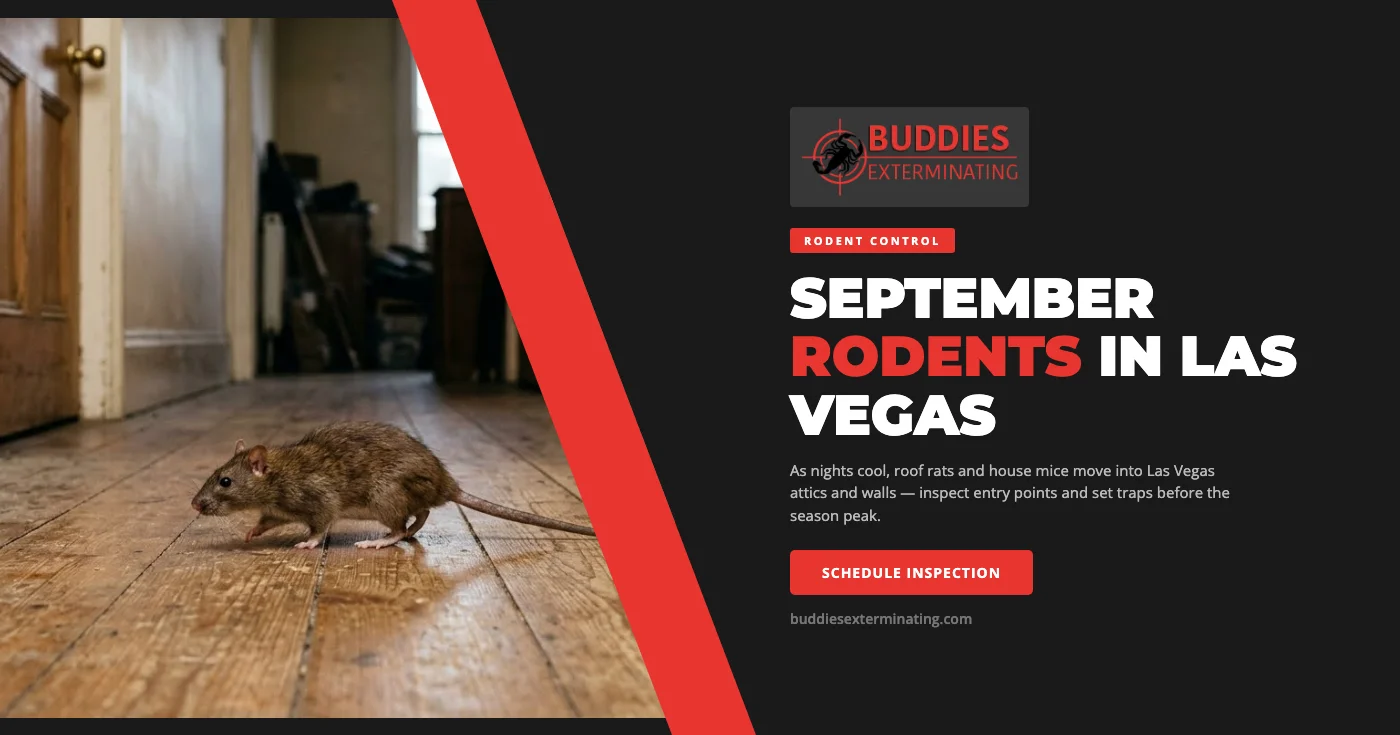
September in Las Vegas brings the first real relief from summer heat — daytime highs slide from the triple digits toward the low 90s, overnight lows drop into the 60s, and monsoon storms taper off. Homeowners feel the change and open a window; roof rats, house mice, and Norway rats feel the same change and start looking for a warm, dry indoor space to nest before winter. At Buddies Exterminating the call volume for rodent control Las Vegas NV families need climbs every year in the last week of August and stays elevated through November, and it almost always tracks the first cool nights.
This guide covers why the seasonal switch matters in the Mojave, how roof rats and house mice enter a Las Vegas home, the warning signs to catch before a population establishes, the health hazards in droppings, the property changes that reduce rodent pressure, and why over-the-counter traps and poisons rarely finish the job.
Why September Changes the Rodent Threat in Las Vegas, NV
Rodent behavior in the desert follows two triggers — temperature and food — and September flips both at once. Rats and mice are homeotherms with a narrow comfort band; when overnight lows in the valley slip from the mid-70s into the low 60s, the same block-wall crevice or palm-tree crown that worked all summer no longer does. The warmest microclimate in every Las Vegas neighborhood becomes the attic, garage, or wall void of a house running its heater on the first cool morning.
Food scarcity does the rest. Monsoon rainfall in July and August drives an outdoor feast — insect activity and plant growth around block walls and irrigation lines — that sustains rodents through summer. When September dries the wash out, that food disappears in weeks and colonies that fed on beetles and patio pet food start scouting garages and pantries. The move indoors is a survival response. New construction across Las Vegas and Henderson adds to the pressure, displacing burrows into older neighborhoods.
How Roof Rats and House Mice Gain Entry to Las Vegas Homes
Two species do most of the damage in the valley. Roof rats (Rattus rattus) are the dominant urban rat across Las Vegas — glossy black or brown, agile climbers, specialists at accessing attics and upper wall voids. House mice (Mus musculus) are smaller, breed faster, and slip through openings a homeowner would swear were closed. Norway rats show up along irrigation ditches and storm drains, but roof rats and house mice are what our technicians pull out of walls most weeks.
The physical limits are humbling. A house mouse compresses through any gap the diameter of a pencil — roughly a quarter of an inch. A roof rat needs about half an inch, or a hole the size of a nickel. Both chew through drywall, insulation, plastic pipe, and sun-brittle weatherstripping to widen a gap. The Centers for Disease Control and Prevention publishes a "Seal Up" protocol built on that reality: any opening a pencil fits into is a mouse door.
The entry points we walk on every September rodent inspection:
- Roof and eave gaps. Roof rats climb block walls and palm trees, cross the tile, and enter through unscreened attic vents, gaps at the fascia line, and unsealed penetrations around swamp coolers and solar arrays.
- Garage door bottoms. A worn rubber sweep leaves a quarter-inch gap the full width of the door — an open freeway for mice and juvenile rats every night.
- Utility penetrations. Gas, water, AC line-set, and cable entries where the caulk cracked in the desert sun are the most common ground-floor entry we find.
- Weep holes and dryer vents. Weep holes at the base of stucco walls and unbaffled dryer vents are mouse-sized entrances most homeowners have never inspected.
- Foundation cracks and pet doors. Hairline foundation cracks in older Las Vegas neighborhoods widen enough for mice within a season, and any opening a housecat uses is an opening a rat can use too.
Early Warning Signs of a Rodent Infestation You Shouldn't Ignore
Sightings are the last sign, not the first. Rodents are nocturnal, cautious, and stay close to walls; by the time a homeowner sees a live rat in the garage or a mouse dart across the kitchen, the population is already established. Watch for these signs in September and October:
- Droppings. House mouse droppings are the size and shape of a grain of rice — 3 to 6 millimeters, pointed on both ends. Roof rat droppings are two to three times larger, 12 to 13 millimeters, slightly curved. Check the tops of water heaters, pantry-shelf corners, and under the kitchen sink.
- Gnaw marks. Rodent incisors grow continuously, so both species chew constantly to file them down. Look for fresh light-colored marks on cabinet corners, pantry containers, and — most concerning — the plastic sheathing on electrical wiring.
- Grease trails. Rats follow the same runways nightly, and the oil in their fur leaves a dark smudge along baseboards, pipe wraps, and rafter edges — a diagnostic sign of an established rat runway.
- Scratching overhead. Roof rats settle into attic insulation and run along the top plate of interior walls after dark. Homeowners often describe the sound as "someone moving boxes in the attic" between 9 p.m. and 4 a.m.
- Nesting material and stale odor. Shredded insulation, pet-food packaging, and dryer lint tucked behind a water heater is a nest — and it is almost never empty. Concentrated urine develops a musty, ammonia-like smell in enclosed spaces.
Health Risks of a Rodent Problem in Your Las Vegas Home
Rodents are not a nuisance-only pest. The CDC links rats and mice to more than 35 human diseases worldwide, several documented in the desert Southwest, and every one travels on droppings, urine, saliva, or parasites.
- Hantavirus Pulmonary Syndrome. Deer mice are the primary reservoir in Nevada, and the virus spreads through aerosolized droppings and urine. Southern Nevada records cases most years, and the risk climbs when a homeowner sweeps or vacuums a contaminated space. CDC guidance: ventilate, wet contaminated surfaces with a bleach solution before cleanup, and never dry-sweep rodent evidence.
- Salmonellosis and leptospirosis. Rodents contaminate pantry food and prep surfaces with bacteria on their feet, and Norway rats near irrigation lines also shed leptospira in urine that survives in standing water — a concern for pets that drink from a patio bowl.
- Allergen exposure. Rodent dander and urine protein are documented triggers for asthma and allergic rhinitis, particularly in children. Attic infestations push those allergens into the living space every time the HVAC cycles.
- Fire and structural damage. Chewed electrical wiring is a leading cause of unexplained house fires, and rodent-damaged insulation and irrigation lines drive four- and five-figure repair bills. This is the invoice our technicians read on almost every attic clean-out.
How to Make Your Las Vegas Property Less Attractive to Rodents
Exclusion and sanitation together do more than any trap or bait ever will. The U.S. Environmental Protection Agency lists the same core tactics we work through on every inspection — remove access, remove food, remove shelter.
Close the openings. Walk the exterior at eye level, then again on a ladder. Seal every hole a pencil fits into with steel wool packed tight and finish with mortar, sheet metal, or hardware cloth — foam and caulk alone are chew-through. Replace worn garage door sweeps, screen the attic vents, and re-caulk every utility penetration.
Cut the food and water supply. Move pet food into metal or thick-walled plastic containers with tight lids and never leave a bowl on the patio overnight. Store birdseed and grill charcoal off the garage floor in sealed bins. Pick fallen pomegranate, fig, and citrus the same day. And fix every drip emitter, pool overflow, or evaporative-cooler drain leak — a full-time water source anchors a colony to your yard.
Eliminate shelter. Trim palm skirts up to at least eight feet — a matted skirt is the most productive roof-rat nesting site in Las Vegas. Keep tree limbs three feet from the roofline so rats cannot bridge to the tile. Clear woodpiles and cardboard stacks off block walls.
Why Professional Rodent Control Beats DIY Methods in Nevada
Every fall we visit homes where a family has spent months rotating snap traps and bait stations and still hears scratching in the ceiling. Consumer approaches fail against an established rodent population for stacked reasons:
- Learned trap aversion. Rats are neophobic — cautious of new objects in a familiar environment — so a snap trap that catches the first two rats often catches nothing for weeks after.
- Poison misuse. Consumer rodenticides used without a tamper-resistant bait station drive secondary poisoning of pets, hawks, and owls across the valley — and typically leave dead rats in wall voids where the carcass smell lasts four to six weeks.
- Ultrasonic devices do not work. Peer-reviewed research has consistently shown no measurable effect on rodent populations. Rodents habituate to sound within days.
- No exclusion and missed harborage. A trap kills the rat inside; it does nothing about the entry point, and the neighbor's colony finds the same hole within the week. Homeowners work the kitchen — but roof rats live in the attic and wall voids where consumer traps rarely land.
Professional rodent control combines a whole-home inspection, targeted trapping in the actual runways, tamper-resistant bait stations placed only where they belong, sealed exclusion at the entry points, and follow-up visits timed to catch juvenile rats maturing into the trap radius.
Frequently Asked Questions About Rodent Control in Las Vegas, NV
How do I know if I have roof rats or mice in my Las Vegas attic?
Overhead scratching between 9 p.m. and 4 a.m., curved raisin-sized droppings on top of the water heater, and grease rub marks along rafter edges point to roof rats. Fine rice-grain droppings and gnaw marks on food packaging point to house mice. A professional inspection with attic access and rodent-track ink strips confirms species and pinpoints the entry.
What should I do if I find rodent droppings in my Las Vegas home?
Do not sweep or vacuum. Ventilate for at least half an hour, put on disposable gloves, mist the droppings with a bleach solution — one part household bleach to nine parts water — and let it sit for five minutes before wiping with paper towels. Double-bag the waste, then call for a professional inspection to find the entry and treat the source.
How fast can a rodent problem grow inside a Las Vegas home?
Fast. A house-mouse pair produces a litter of five to seven pups every three weeks, and those pups reach breeding age at six to ten weeks. Roof rats produce four to five litters a year with five to eight pups each. A late-September introduction can become dozens of animals inside the walls by December.
Are professional rodenticides used in Las Vegas homes gentle around pets and children?
Modern professional programs rely on tamper-resistant bait stations that no child or household pet can access, placed only in exterior perimeter locations. Interior work is inspection, exclusion, and targeted trapping — not loose bait. That is the difference between a professional program and a hardware-store bag of bait blocks, which cause hundreds of accidental pet poisonings across the country every year.
Why Las Vegas Homeowners Choose Buddies Exterminating for Rodent Control
Rodent control Las Vegas NV homes need in September has to match how roof rats and house mice actually move — an inspection that includes the attic and every exterior penetration, exclusion that closes the specific gaps a rodent could use, targeted trapping in the actual runways rather than blind placement, and follow-up visits that catch the next wave before it establishes.
Our fall rodent program at Buddies Exterminating starts with a full interior and exterior inspection — attic access included — then pairs a written exclusion plan for the exterior openings we find with an integrated treatment inside. We service Las Vegas, Henderson, North Las Vegas, Summerlin, Spring Valley, Paradise, Enterprise, Green Valley, Whitney, and Winchester. If overhead scratching, fresh droppings on the water-heater shelf, or gnaw marks on pantry containers have shown up as the nights cool down, book a professional rat and mice extermination inspection — contact our team before the first cold snap.