
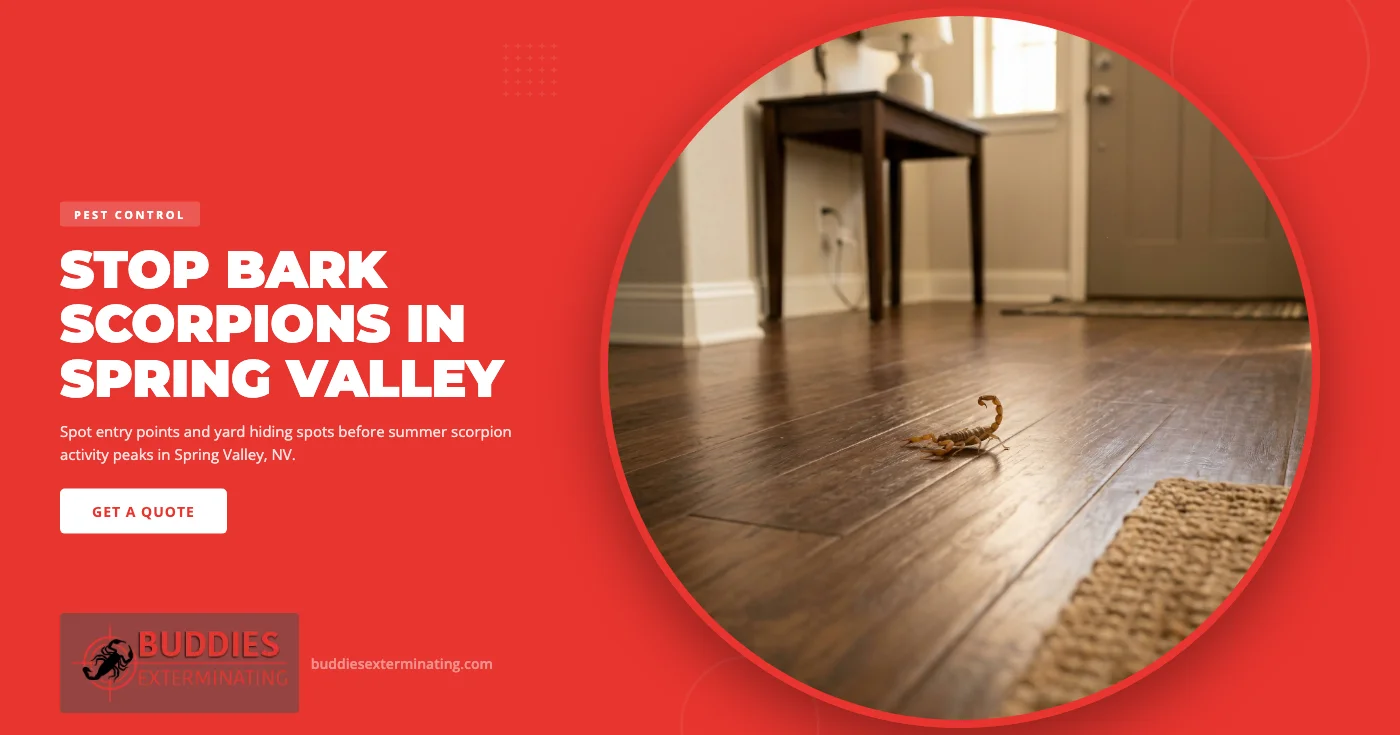
If you live in Spring Valley and you've found a scorpion inside this summer, you're already on a clock. The Arizona bark scorpion is the species behind almost every concerning sting in southern Nevada, and Spring Valley sits in some of the highest-activity terrain in the Las Vegas Valley — older neighborhoods, rocky native landscaping, washes, and irrigated yards backing onto open desert. Scorpion control in Spring Valley, NV isn't about a single spray. It's about understanding why scorpions are coming inside, sealing the routes they use, and removing the moisture and harborage that's pulling them onto the property in the first place. At Buddies Exterminating, we work scorpion calls across Spring Valley, Summerlin, Enterprise, and the rest of the Las Vegas area every summer, and the calls cluster around the same patterns year after year. This guide covers what makes Spring Valley a hotspot, how to identify a bark scorpion vs. the other species you'll see locally, where they hide, and what actually keeps them out.
Why Spring Valley, NV Has High Bark Scorpion Activity in Summer
Spring Valley's geography stacks the deck in the bark scorpion's favor. The neighborhood sits along the west side of the valley below Red Rock, with developments built into rocky terrain that's been bark scorpion habitat for thousands of years. Newer construction sits on top of old desert wash channels; older neighborhoods bring decades of native rock landscaping and mature plantings up close to homes. Both create perfect daytime harborage — gaps under rocks, expansion joints in older concrete, rough stucco at the slab line, and irrigation moisture inside dense plantings.
Heat is the trigger that turns habitat into infestation. Bark scorpions become highly active once nighttime temperatures consistently stay above 77°F — typically late April through early October in Spring Valley, with peak activity in June, July, and August. Extreme daytime heat also drives them indoors looking for cooler, more stable shelter and any reliable water source. A Spring Valley home with irrigated landscaping inside a stucco shell sitting on a 110°F desert is essentially a luxury hotel for a heat-stressed bark scorpion. The combination of evening activity, summer heat-driven indoor migration, and ample habitat is why we field more scorpion calls in July and August than the rest of the year combined.
How to Identify a Bark Scorpion vs. Other Desert Species
Two scorpion species drive nearly every Las Vegas-area call: the Arizona bark scorpion (Centruroides sculpturatus) and the larger desert hairy scorpion (Hadrurus arizonensis). They're easy to mix up if you've never compared them up close, but they behave very differently and the sting risk is not the same.
- Arizona bark scorpion. The species that matters most for sting risk. Slender, 2 to 3 inches long, light tan to straw-yellow, with a thin tail held curved to the side rather than over the back. Pincers are long and slender. Climbs walls, ceilings, and screens — the only common Nevada scorpion that does. Often clings upside-down inside cabinets, behind picture frames, and on the underside of shoes. The bark scorpion's sting can produce significant pain, numbness, and in some cases more serious medical effects, especially in children and older adults.
- Desert hairy scorpion. Much larger, 4 to 6 inches, with a bulky body, large pincers, and a yellowish-tan color with a darker back. Does not climb vertical surfaces. Generally stays in burrows and prefers open desert and rock piles. Sting is reported as comparable to a strong bee sting — painful but not medically serious in healthy adults. Found outdoors much more often than indoors.
- Yellow ground scorpion. Smaller, around 2 inches, plain yellow-tan, with stubby tail and pincers. Mostly outdoor, rarely climbs, sting is mild.
The fastest field test: a UV blacklight after dark. All scorpions fluoresce bright blue-green under UV. A 2- to 3-inch slender scorpion clinging to a vertical surface or hanging upside down is almost certainly a bark scorpion. Anything else outdoors at ground level is more often one of the larger or smaller species. If you've identified bark scorpions on the property, the response needs to be different from finding the occasional desert hairy in the yard.
Where Scorpions Hide Inside and Around Your Spring Valley Home
Bark scorpions are crevice specialists. They want tight, dark, slightly humid hideouts close to insect prey. The harborage map in a typical Spring Valley home is consistent enough that we know where to look on the first inspection.
Outdoor harborage:
- Under rocks, pavers, decorative boulders, and patio stones — especially within the first 10 feet of the house
- Inside block walls, the gaps behind retaining walls, and weep holes in stucco
- In bark mulch beds — moisture-retaining mulch is one of the worst landscape choices in scorpion territory
- Around irrigation valve boxes and drip-line risers, especially where there's a slow leak
- In stacked firewood, lumber piles, and outdoor storage piled against the house
- Behind exterior trim, under loose stucco, and inside expansion joints at the slab line
- Inside garage corners, behind storage boxes, and on the underside of shelving
Indoor harborage:
- Bathrooms, kitchens, and laundry rooms — water sources draw them in
- Inside shoes, boots, and gloves left on garage and closet floors
- Behind picture frames, under bedside lamps, and along baseboards in bedrooms
- Inside cabinets, especially under sinks where plumbing penetrations let them in
- In attic spaces and on the underside of roof rafters — bark scorpions climb and drop
- Inside ceiling light fixtures and exhaust fan housings
If you've seen one bark scorpion inside, there are almost always more — they're territorial enough that one indoor sighting points to a route and a harborage spot somewhere on the property.
Entry Point Sealing: Gaps and Cracks Scorpions Use to Get In
Bark scorpions can fit through an opening as thin as a credit card. Sealing entry points is the most durable layer of scorpion pest control any homeowner has access to.
- Gaps under exterior doors. The single most common entry route. Replace torn door sweeps, install brush-style sweeps on garage entry doors, and check that side seals are intact.
- Garage door bottom seal. Worn or damaged garage door seals leave a continuous gap across the width of the door. Replace seasonally if needed.
- Window screens. Torn screens, gaps at the frame, and screen-less windows that get left open at night are common indoor sighting sources.
- Weep holes in stucco. These are required for drainage but should be covered with weep-hole screens that pass water and block insects and scorpions.
- Expansion joints and stucco-to-slab gaps. The joint where the stucco wall meets the foundation slab is a major entry point. Caulk with a quality polyurethane sealant.
- Utility penetrations. Gas line, water line, electrical conduit, AC line set, and dryer vent penetrations all need sealing where they enter the building envelope.
- Garage corner gaps. The corner where the garage slab, exterior wall, and door frame meet often has a gap large enough for a bark scorpion. Caulk it.
- Roof and attic vents. Bark scorpions climb. Make sure attic vents have intact screens, and that any roofline penetrations are sealed.
- Door thresholds in older homes. Settled foundations create gaps under interior thresholds. Adjustable thresholds with new seals fix them.
A weekend of thorough sealing — door sweeps, weep hole screens, expansion joint caulk, utility penetrations — cuts indoor sightings dramatically on most Spring Valley properties.
Yard Changes That Make Your Property Less Appealing to Scorpions
Sealing the home keeps scorpions out. Changing the yard reduces how many show up at the wall in the first place. Most of these changes also help with crickets, roaches, and the other insects bark scorpions feed on — which compounds the benefit.
- Replace bark mulch with gravel or decomposed granite within 3 feet of the home. Mulch retains moisture and creates the cool, humid microclimate scorpions favor. Rock dries fast and offers less shelter.
- Pull dense plantings back from the foundation. Shrubs touching the wall create harborage and hide entry points. A 12- to 18-inch gap between plants and stucco helps.
- Fix irrigation leaks. Slow drips at drip emitters near the foundation create the moisture corridor that pulls scorpions in. Replace failed emitters and walk the irrigation lines monthly through summer.
- Move firewood, lumber, and outdoor storage off the ground and away from the house. Anything stacked against the wall is harborage by definition. Move it 20+ feet out and elevate it.
- Pick up loose rocks, pavers, and decorative stones near the house. Every rock is a potential bark scorpion daytime hiding spot.
- Reduce outdoor lighting near doors at night. Bright lights at the back door pull in the moths, crickets, and other prey insects that bark scorpions hunt. Move lighting away from entry points, use motion sensors, or switch to warm yellow bulbs that attract fewer insects.
- Manage block walls and retaining walls. Caulk visible cracks, fill weep holes that aren't draining usefully, and inspect after seasonal settling.
- Address the wider insect population. Fewer crickets and roaches in the yard means less food keeping scorpions on the property. Routine pest control services handle this layer as part of the regular program.
How Professional Scorpion Treatment Works
Effective scorpion control in Spring Valley, NV homes is not a single spray-and-leave visit. The treatment plan we use on most properties stacks several layers because no single one solves it:
- Nighttime UV inspection. The only way to find the actual population on the property is to walk the perimeter, foundation, and harborage spots with a UV blacklight after dark. We map activity zones and use that map to direct treatment.
- Crack-and-crevice treatment. Targeted dust or microencapsulated product into expansion joints, weep holes, utility penetrations, block wall voids, and other harborage. This is where bark scorpions actually live.
- Perimeter barrier. A residual product applied to the foundation, lower walls, and harborage spots in the first 10 feet around the home. Scorpions crossing it pick up the product and don't survive long.
- Granular bait or treatment for the insect prey base. Reducing the cricket and roach population reduces the food source pulling scorpions toward the home.
- Indoor crack-and-crevice work as needed. Targeted treatment at confirmed indoor harborage points — under sinks, along the slab line in garages, behind appliances.
- Recurring service every 60 to 90 days through scorpion season. Residual products break down over weeks in Nevada summer heat. A 90-day cycle is typically the maximum interval that maintains a working barrier through July and August.
Most properties see a clear drop in sightings after the first full visit, with the second visit (4 to 6 weeks later) showing the durable change. Properties with persistent activity usually need a structural fix — a yard-side gap that hasn't been sealed, a leaking irrigation line, or active harborage in a feature like a stacked retaining wall that needs attention before treatment alone can close the gap.
Frequently Asked Questions
Why am I finding scorpions in my Spring Valley house in the middle of summer?
A combination of factors. Spring Valley sits on prime bark scorpion habitat, summer heat drives them inside looking for cooler shelter and water, and most homes have a few entry points wide enough for a bark scorpion to crawl through. Once one is inside, others usually follow the same route.
Are bark scorpion stings dangerous?
Bark scorpion venom can produce significant pain, numbness, and in some cases more serious effects, particularly in children, older adults, and people with cardiovascular or respiratory conditions. Most stings to healthy adults are very painful but resolve in 24 to 72 hours. Any sting to a child should be evaluated by medical professionals.
How do bark scorpions get into homes in Spring Valley?
Through gaps under doors, around utility penetrations, in stucco-to-slab expansion joints, through unscreened weep holes, and via attic vents and roofline gaps when they climb. A credit card-thin gap is enough.
Does scorpion treatment have to be repeated every month?
No. Most Spring Valley homes do well on a 60- to 90-day recurring cycle during scorpion season (April through October), with an off-season cadence over winter. Properties with severe activity sometimes start at a 30-day interval until the population is knocked back.
Will sealing my home stop bark scorpions completely?
Sealing is the most durable layer, but no Spring Valley home is fully scorpion-proof on entry alone. Sealing combined with yard changes and a professional perimeter barrier is what gets most properties to zero or near-zero indoor sightings.
Don't Wait for the Next Sighting
Spring Valley homes that come through summer with no scorpion sightings have usually done three things: sealed entry points before the heat arrived, pulled mulch and dense plantings back from the foundation, and started a recurring perimeter and crack-and-crevice treatment by late April or early May. The homes finding bark scorpions in shoes and cabinets in July almost always skipped one of those steps. If you've already seen a scorpion inside, the path forward is a thorough inspection — including a nighttime UV walk — followed by targeted treatment of the harborage and the entry routes. Buddies Exterminating serves Spring Valley, Summerlin, Enterprise, and the rest of the Las Vegas area. Get on a scorpion-season schedule before the next stung-foot story is yours.