
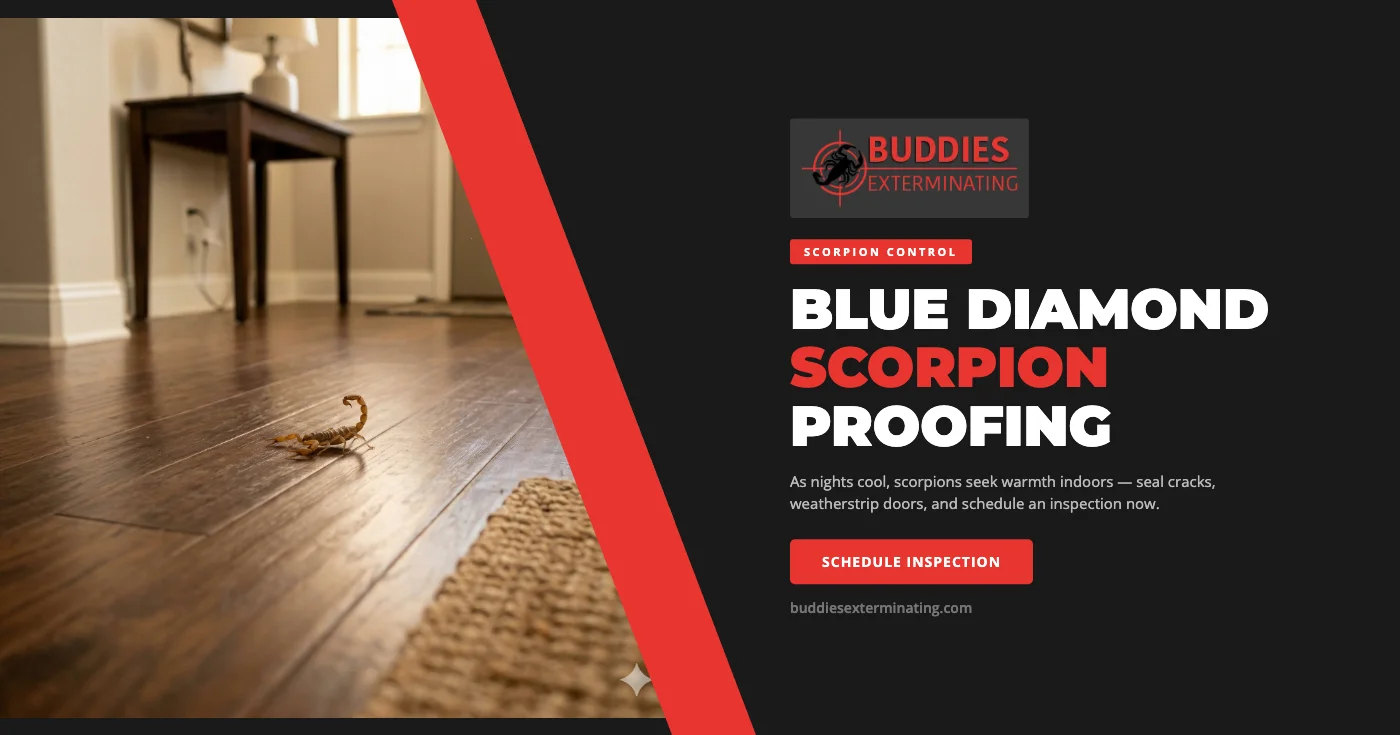
Blue Diamond sits at the mouth of Red Rock Canyon with open Mojave desert on three sides and no meaningful buffer between bark scorpion habitat and the front door. Every late August and September we get the same call at Buddies Exterminating — a Blue Diamond homeowner finds a slender tan scorpion inside a shoe or clinging upside-down under a cabinet, and wants to know how it got in. The honest answer is almost always the same: a gap in the building envelope thin enough for a credit card. This guide covers how bark scorpions enter a desert home, exactly which routes to seal before fall temperatures push more of them inside, and the yard changes that reduce pressure on the perimeter in the first place.
The reason to act now — not in October — is behavioral. Bark scorpions do not go dormant when nights cool; they migrate. Late-summer lows in the mid-80s keep them hunting outdoors, but as September and October bring 60°F nights, the same population presses against the warmest, most stable microclimate available: the inside of a house. Sealing entry routes in late August catches the migration before it starts.
Why Blue Diamond, NV Homes Face High Scorpion Activity in Late Summer
Blue Diamond is roughly 15 miles southwest of the Las Vegas Strip, tucked against Red Rock Canyon National Conservation Area at about 3,500 feet of elevation. The community sits inside prime Arizona bark scorpion (Centruroides sculpturatus) habitat — rocky Mojave transition zone, cottonwood-lined washes, and Bureau of Land Management open desert butting directly against residential lots. There is no suburban buffer between homes and habitat.
Property size is part of what makes the pressure different from Summerlin or Henderson. Blue Diamond has roughly 300 permanent residents on lots ranging from historic ranch parcels to newer desert builds. Older ranches bring decades of settled foundation cracks, aging weep hole screens, and expansion joints widened by seasonal movement. Newer builds tend to have tighter envelopes but rely on landscape features — decorative boulders, dry riverbeds, mature cactus beds — that create textbook bark scorpion harborage against the foundation.
Seasonality closes the loop. Bark scorpions become highly active once nighttime temperatures stay above 77°F, typically late April through early October in the Las Vegas Valley. As the ground cools in late August and September, that same population shifts strategy — hunting outside on warm nights and pressing indoors on cool ones. This transitional window is when indoor sightings spike, and the reason we schedule Blue Diamond seal-and-treat visits before Labor Day rather than after the first indoor find.
How Bark Scorpions Get Into Your Home
Bark scorpions are the only common Nevada scorpion that climbs vertical surfaces, and their body geometry lets them squeeze through openings almost no other pest can. According to University of Arizona Cooperative Extension guidance, a mature bark scorpion can flatten itself to pass through a gap as narrow as 1/16 of an inch — roughly the thickness of a credit card. That single fact rewrites the entry-point map for any Blue Diamond home.
Three behaviors compound the problem. They climb — ascending stucco, block wall, wood siding, and even smooth interior drywall, which makes roofline vents, second-story window screens, and soffits legitimate entry points, not just ground-level ones. They follow prey — hunting crickets, roaches, and silverfish, so any house that draws prey draws scorpions right behind them. And they seek stable microclimate — a Blue Diamond home in September holds a steady 72°F while the desert outside swings 40°F in a single day, and once one scorpion finds a viable route, the local population has a reason to try it.
Effective scorpion control Blue Diamond NV residents can depend on treats the entry map as a system, not a single spray. Perimeter treatment kills the scorpions that walk through it — it does not close the doorways. Sealing is the durable layer; treatment is the reinforcement.
The Most Vulnerable Entry Points Scorpions Use in Nevada Homes
Every Blue Diamond home we inspect turns up variants of the same short list. Knowing where to look is most of the battle, because most of these routes look like nothing until a scorpion uses one.
- Weep holes and weep screed at the stucco base. Required for drainage, but a bare weep hole is a bark scorpion highway. Screen every opening with insect-grade weep hole screens that pass water and block arthropods.
- Expansion joints and the stucco-to-slab gap. The joint where a stucco wall meets the foundation slab is the single largest continuous entry point on most desert homes — it runs the full perimeter and widens with seasonal settling.
- Garage door bottom seal. A worn seal leaves a continuous gap across the width of the door — often the widest opening in the entire building.
- Exterior door sweeps and thresholds. The gap under a front door, back slider, or garage entry door is the most common indoor sighting source we see. Brush-style sweeps outperform vinyl in dusty desert conditions.
- Utility penetrations. Gas lines, electrical conduit, water lines, AC line sets, dryer vents, and cable entries all leave gaps that need caulking or foam sealing.
- Attic vents, gable vents, and soffit gaps. Bark scorpions climb. Attic entry through a torn vent screen is not theoretical — we find it every year on older Blue Diamond ranches.
- Window screens and frames. Torn screens and gaps at the frame are common routes, particularly on bedroom windows opened at night.
- Block wall interfaces and retaining walls. Block wall voids are prime bark scorpion daytime harborage; inspect every seam and weep opening.
Step-by-Step: How to Seal Your Blue Diamond Home Against Scorpions
A weekend of thorough sealing on a Blue Diamond home cuts indoor sightings dramatically. Work the exterior first, top to bottom, then re-check the interior transitions.
1. Install or verify weep hole screens. Walk the stucco perimeter with a flashlight. Any open weep hole gets a bronze or stainless weep screen pressed firmly in. Do not caulk them shut — they exist for drainage.
2. Caulk the stucco-to-slab gap. Use a polyurethane sealant rated for exterior masonry and expansion. Run a continuous bead along the joint where the stucco meets the foundation slab, all the way around the house. This is the highest-leverage single move on almost every Blue Diamond home we service.
3. Replace worn door sweeps and garage seals. Every exterior door needs a functioning brush sweep with no visible daylight underneath. Replace the garage door bottom seal if you can see gaps at the corners.
4. Seal utility penetrations. Any gap wider than 1/16 of an inch around a gas line, conduit, water line, AC line set, or dryer vent gets caulk, expanding foam, or a properly sized escutcheon plate. Do the AC line set entry twice — the desert sun destroys the first seal within a year.
5. Repair or re-screen attic and gable vents. Fine-mesh insect screening behind every vent grille. Torn screens get replaced, not patched.
6. Inspect window screens and frames. Small tears get replaced. Add weatherstripping to sliding windows with visible gaps at the frame.
7. Address interior transitions. Caulk baseboards where you see floor gaps, and pack copper mesh or steel wool around plumbing penetrations under sinks. This layer catches the scorpion that made it past the exterior seal.
How to Reduce Scorpion Attractants Around Your Property
Sealing keeps scorpions out. Changing the yard reduces how many show up at the wall in the first place. These changes also cut cricket, roach, and silverfish pressure, which starves the food supply that pulls scorpions onto the property.
- Replace bark mulch with gravel or decomposed granite within three feet of the home. Organic mulch retains moisture and creates the cool, humid microclimate scorpions favor. Rock dries fast and offers less shelter.
- Pull dense plantings back from the foundation. Shrubs and ornamental grasses touching the wall create harborage and hide entry points. A 12- to 18-inch gap between plant material and stucco lets you see what is actually against the house.
- Fix irrigation leaks. Slow drips at emitters near the foundation build a moisture corridor that pulls bark scorpions inward. Walk drip lines monthly through summer.
- Move firewood and outdoor storage away from the house. Anything stacked against the wall is harborage by definition — relocate it 20 feet out and elevate it on a rack.
- Pick up loose rocks and decorative stones near the foundation. Each rock is a candidate daytime hiding spot within striking distance of the entry points you just sealed.
- Move outdoor lighting away from doors. Bright lights at entries pull in the moths and crickets bark scorpions hunt. Use motion sensors, warm-color LED bulbs, or lights mounted 15 feet away aimed back at the door.
- Suppress the prey population. A routine perimeter program that keeps crickets, roaches, and silverfish down cuts the food supply bark scorpions are following.
When DIY Methods Aren't Enough: Signs You Need Professional Help
A homeowner willing to spend a weekend on the sealing checklist above can move the needle meaningfully on a Blue Diamond property. There are situations, though, where the honest recommendation is a professional program, and the pattern is consistent enough to name.
- Multiple indoor sightings in a single week. One bark scorpion inside means a route exists. Three or four indoor sightings in seven days means the route is established, the population is significant, and the harborage is close.
- Any sighting near a child's bedroom. The U.S. Centers for Disease Control and Prevention identifies the bark scorpion as the only U.S. scorpion with venom potent enough to cause serious complications, and children under six carry the highest risk of severe response. A confirmed bark scorpion in or near a child's sleeping area is grounds to call for a nighttime UV blacklight inspection immediately.
- Visible harborage you cannot access. Block wall voids, attic runs, wall cavities, and crawlspaces beyond what a homeowner can carefully inspect need professional treatment tools and access techniques.
- A prior spray program that didn't hold. Consumer-grade insecticides break down quickly in Nevada summer heat and rarely reach the crack-and-crevice harborage where bark scorpions actually live. If a hardware-store perimeter treatment stopped working within weeks, the problem is not the product — it is the placement.
- Nighttime scorpion sightings on the exterior. A UV blacklight walk of the property after dark tells the full story. If the flashlight lights up more than a couple of bark scorpions in a single pass, the pressure is high enough that a professional perimeter and crack-and-crevice program will pay for itself the first month.
Our approach to a professional Blue Diamond scorpion program includes a nighttime UV blacklight inspection of the foundation and first 10 feet of yard, targeted crack-and-crevice treatment into expansion joints, weep holes, utility penetrations, and block wall voids, a residual perimeter barrier, indoor spot treatment at any confirmed harborage, and follow-up visits on a 60- to 90-day rotation through the active season. When the inspection turns up cricket or roach pressure, we fold that into the same visit through our broader pest services lineup — reducing the prey population is part of scorpion control, not a separate program.
Frequently Asked Questions About Scorpion Control in Blue Diamond, NV
How small a gap can a bark scorpion fit through?
About 1/16 of an inch — roughly the thickness of a credit card. Most homeowners assume "sealed" means visually tight, when the real threshold is much smaller. If a business card slides into a gap, a bark scorpion can flatten and pass through.
When is the best time to scorpion-proof a Blue Diamond home?
Late August through mid-September, before cooling nights push the outdoor population indoors. The second-best time is the day after the first indoor sighting.
Is a bark scorpion sting dangerous?
The CDC classifies the bark scorpion (Centruroides sculpturatus) as the only U.S. scorpion with venom potent enough to cause serious complications. Most adult stings produce intense localized pain and numbness for several hours. Children under six, older adults, and people with underlying health conditions can experience more serious reactions and should be evaluated urgently. An FDA-approved antivenom (Anascorp) exists for severe cases.
Do bark scorpions climb walls and get into attics?
Yes. Bark scorpions are the only common Nevada scorpion that climbs vertical surfaces. Roofline vents, second-story windows, and soffits belong on the sealing checklist alongside ground-level routes.
Will one professional treatment eliminate scorpions on my property?
No single treatment eliminates a bark scorpion population. What a professional program does is drive activity down to a manageable level, close entry routes, treat harborage, and hold the perimeter through the active season with follow-up visits. Long-term control is a program, not an event.
Why Blue Diamond Residents Trust Buddies Exterminating for Scorpion Control
Scorpion control Blue Diamond NV homeowners can rely on has to match how bark scorpions actually behave — the credit-card gap they exploit, the vertical routes they climb, the prey they follow, and the seasonal migration that pushes them indoors as families open windows in the cooler evenings. Our Blue Diamond scorpion pest control program starts with a nighttime UV blacklight inspection to map the population and harborage on the property, pairs that with targeted crack-and-crevice treatment into every entry route we identify, and holds the perimeter with a 60- to 90-day rotation through the active season.
We work Blue Diamond, the Route 159 corridor, the western edge of Enterprise, Spring Valley, Summerlin, and the rest of the Las Vegas Valley, and we build every scorpion program around sealing plus treatment rather than treatment alone. If you have found a bark scorpion inside, seen one on a block wall at night, or want to get ahead of the fall migration before it hits the sleeping areas, contact our team to schedule a Blue Diamond scorpion inspection.