
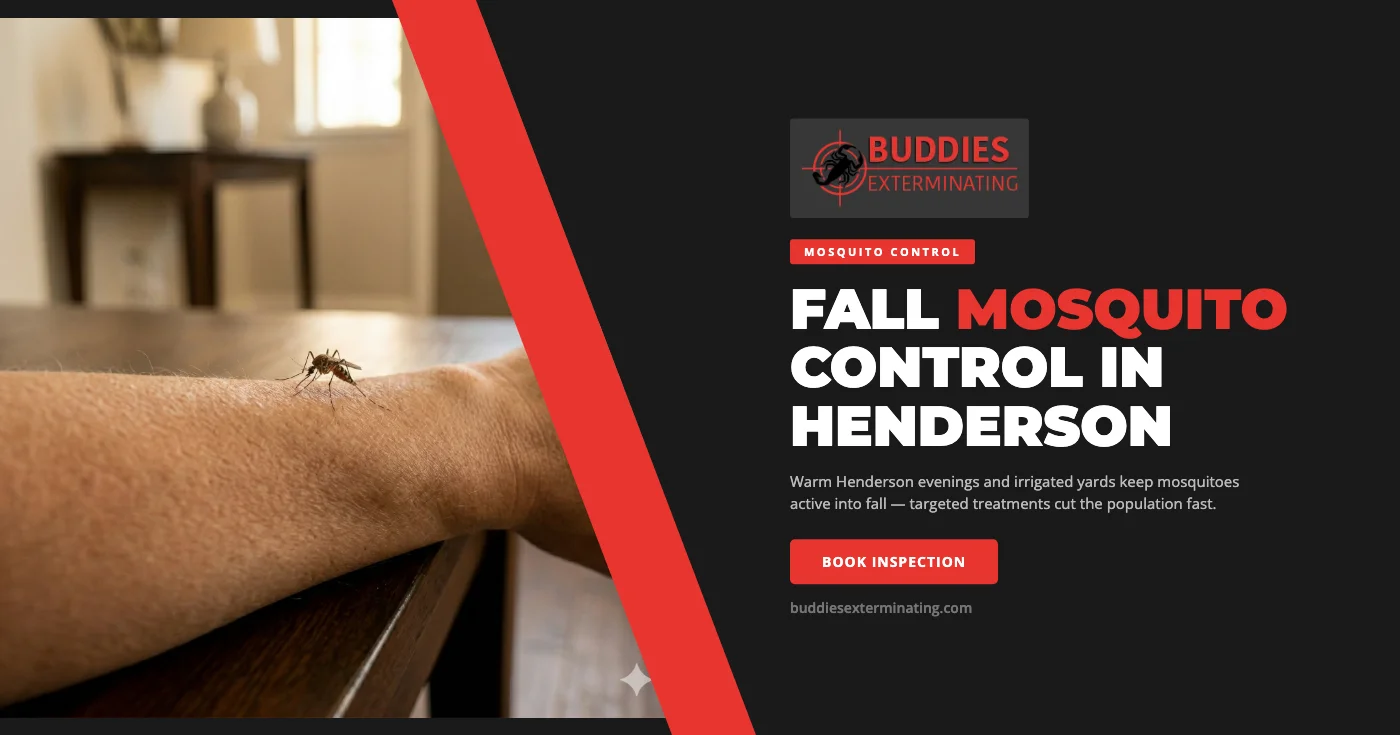
Monsoon season may officially wrap in September, but in Henderson, NV, the mosquitoes it seeded stay busy well into fall. Standing water from late-season storms doesn't dry out as fast as it feels like it should, and Culex mosquitoes — our region's primary West Nile virus carriers — keep biting as long as daytime highs stay mild. If you are looking into mosquito control in Henderson, NV before the last warm weeks of the season slip away, this is the window that matters.
At Buddies Exterminating, we work Henderson and the wider valley through every stage of mosquito season, and the fall push is the one homeowners consistently underestimate. Below we cover why mosquitoes stick around after monsoon rains stop, where they actually breed on Henderson properties, the health risks that peak this time of year, what you can do at home, and where professional mosquito control in Henderson, NV fits in.
Why Henderson, NV Still Has Mosquitoes After Monsoon Season Ends
Southern Nevada's monsoon season runs from mid-June through the end of September. By early October, storms ease off — but mosquitoes do not disappear with the last thunderclap. Several overlapping conditions keep them going through fall in Henderson.
- Standing water lingers long after the storms stop. Rain that pooled in gutters, planters, tarps, and low spots during August and September can still be sitting there in October — a fresh mosquito nursery in every container.
- Henderson's mild autumn keeps the breeding cycle running. Daytime highs in the 80s and 90s well into October mean the full egg-larva-pupa-adult cycle can still complete in a week or less.
- Newer neighborhoods have more standing water than people realize. Master-planned communities across Henderson — Green Valley, Anthem, Inspirada, MacDonald Ranch, Cadence — feature ornamental water, HOA retention basins, and heavily drip-irrigated yards that hold water in ways older desert lots never did.
- Adult mosquitoes push harder for a blood meal in fall. Females that will overwinter need a final blood meal to sustain them, which is why the "last mosquitoes of the season" often feel more aggressive than the ones you dealt with in July.
- The Southern Nevada Health District extended monitoring last season. Mosquito surveillance across Clark County started about a month earlier than usual and ran later into fall — a signal that the pressure window is widening on both ends.
How Standing Water in Henderson Yards Creates New Mosquito Breeding Grounds
Mosquitoes are built to exploit short-lived water. According to the CDC, even a bottle cap of stagnant water can support a batch of eggs. In Henderson yards after monsoon season, the accumulated pools add up quickly.
How the breeding cycle works after a fall storm
- A single female can lay 100–300 eggs at once. Some species lay floating egg rafts; others glue eggs to the inside walls of containers where they wait for the next refill.
- 7–10 days of undisturbed water is all it takes. In Henderson's warm October afternoons, that timeline often runs closer to a week.
- Eggs from monsoon season can still hatch weeks later. Certain mosquito eggs remain viable for months in dried-out containers, waiting for the next dose of water — including a hose refilling a bucket or an unexpected fall rain.
- Multiple species overlap in the valley. Culex quinquefasciatus, our primary West Nile virus carrier, breeds in stagnant water with organic material. More aggressive day-biting Aedes species have established populations across the valley and reproduce in much smaller containers.
The Most Common Mosquito Breeding Spots Henderson Homeowners Miss
When we walk a Henderson property, the same handful of breeding sites show up over and over.
- Clogged or sagging rain gutters holding shallow pools you can't see from the ground — one of the top hidden breeding sites in single-family neighborhoods.
- Plant saucers, decorative pots, and drip trays. A quarter inch of water in the base of a potted plant is enough for a generation of larvae.
- Low spots in gravel, decomposed granite, and pavers. Desert hardscape creates shallow bowls that hold water for several days after a storm.
- Pool covers, tarps, and stored patio furniture that trap rainwater in folds and pockets for a week or longer.
- Outdoor dog bowls, chicken waterers, and livestock troughs. Anything that doesn't get refreshed every few days becomes a productive breeding site, especially in shaded corners.
- Old buckets, kids' toys, and wheelbarrows. Forgotten five-gallon buckets are among the most reliable breeding containers we find.
- AC condensate drains that pool at the foundation right next to where people sit outside.
- Irrigation overspray and drip-line leaks. A single leaking emitter creates a persistent damp patch that quietly produces mosquitoes for weeks.
- Ornamental ponds, fountains, and rock waterfalls without circulation — one of the biggest single sources of mosquitoes on newer Henderson properties.
- HOA retention basins. When these hold water for more than a week, they produce enough mosquitoes to affect every yard within several blocks.
Health Risks of Late-Season Mosquitoes in the Las Vegas Valley
Mosquitoes in Southern Nevada are more than an itchy nuisance — the valley has a documented history of mosquito-borne disease activity.
- West Nile Virus. The most closely monitored mosquito-borne disease in our area, carried primarily by Culex mosquitoes. Clark County has confirmed both mosquito-pool detections and human cases in past seasons, and local activity typically peaks in late summer and early fall.
- St. Louis Encephalitis. Another Culex-borne virus that usually causes flu-like symptoms but can progress to serious neurologic illness in older adults.
- Travel-related dengue and Zika. Neither is currently endemic to Nevada, but the Aedes mosquitoes capable of transmitting them now have established populations in the valley.
- Heartworm in dogs. Mosquitoes are the vector for canine heartworm, and fall walks mean more exposure for pets. Heartworm treatment is far more difficult than prevention.
Homeowners who spot stagnant water on public land or in a neglected neighboring property can report it through the Southern Nevada Health District's mosquito surveillance program.
What Homeowners Can Do Right Now to Reduce Mosquito Activity
Source reduction — eliminating the standing water mosquitoes need to breed — is still the single highest-impact habit at the homeowner level. The CDC recommends emptying, scrubbing, turning over, or covering anything that holds water at least once a week. Done consistently across a Henderson property through fall, that one habit stops thousands of mosquitoes before they hatch.
- Walk the property within 24 hours of any rain. Do a quick lap and empty every container. Anything still holding water four or five days later is a confirmed breeding site — treat it as one.
- Scrub outdoor containers weekly. Don't just pour the water out. Scrub the inside — mosquito eggs cling to the walls and hatch the next time water collects.
- Flush and re-check gutters. Fall leaves block drainage. Clear gutters now, then re-check 48 hours after the next rain. If water is still pooling, they need re-pitching.
- Refresh pet and livestock water every few days. For larger troughs and features that can't be emptied easily, mosquito-control dunks containing BTi (Bacillus thuringiensis israelensis) target mosquito larvae without harming livestock, birds, fish, or beneficial insects.
- Grade and fix the puddles that always come back. Low spots in gravel and DG that pool every storm need to be leveled or redirected — a single persistent puddle can produce hundreds of mosquitoes per week.
- Repair irrigation overspray and drip leaks. Walk the drip lines once a month; damp patches and ponding at emitters should be fixed.
- Use repellent during peak biting hours. Dawn and dusk are the heaviest biting windows. EPA-registered repellents containing DEET, picaridin, oil of lemon eucalyptus, or IR3535 are the most reliable options for skin protection.
When DIY Mosquito Prevention Is Not Enough in Henderson, NV
Plenty of Henderson homeowners reach for a hose-end sprayer or a store-bought fogger after the first bad week of bites. We understand the instinct — and we also see the pattern of why those efforts usually fall short.
- Over-the-counter sprays knock down adults, not eggs and larvae. A consumer fogger might clear the yard for an evening, but within days a fresh wave of adults emerges from the breeding sites nearby.
- Application timing rarely matches mosquito behavior. Mid-afternoon spraying misses the mosquitoes resting in shaded vegetation, and the early-morning and post-dusk biting windows go untreated.
- Coverage is limited on larger properties. Many Henderson lots — especially in Anthem, Seven Hills, and MacDonald Ranch — have mature landscaping and shaded resting spots that consumer sprays cannot penetrate.
- Weather washes treatments off quickly. Fall rains and irrigation overspray rinse residual products off vegetation within hours.
- Over-application creates its own problems. Broad spraying of lawns and play areas exposes pets, kids, and pollinators to more product than needed — and still misses the actual breeding sites.
Professional Mosquito Control in Henderson from Buddies Exterminating
When homeowners reach out to us about mosquito control in Henderson, NV, we work every property the same way: find the breeding sites, treat the larvae, knock down the adults in their daytime resting areas, and put a recurring schedule in place that matches the tail end of the warm season.
What our fall mosquito service typically includes
- Property walkthrough and breeding-site audit. Before we treat anything, we map every standing water source — gutters, planters, ornamental features, irrigation, low spots — and flag the ones the homeowner should address directly.
- Larvicide treatment of water that can't be removed. For ornamental ponds, water features, and troughs that need to stay in place, we use targeted larvicides that interrupt the breeding cycle without disrupting the rest of the yard.
- Targeted adult-mosquito treatment of resting areas. Adult mosquitoes spend most of the day tucked into dense vegetation, under decks, and inside shrub beds. We focus treatments there instead of blanket-spraying open turf.
- Recurring service through the tail of the warm season. Because each fall storm or irrigation cycle can reset the breeding clock, mosquito control this time of year works best as a short recurring program rather than a one-shot spray.
- Coordination with your broader pest plan. Many customers fold fall mosquito service into a recurring plan that also covers scorpions, spiders, cockroaches, and rodent prevention heading into winter.
Frequently Asked Questions About Mosquito Control in Henderson, NV
How late in the year do mosquitoes stay active in Henderson?
Culex mosquitoes can remain active into November as long as daytime temperatures stay mild. Cold snaps slow them down, but a stretch of warm afternoons will bring biting activity right back — which is why fall treatments matter.
How long does a professional mosquito treatment last?
Most treatments provide several weeks of meaningful reduction in adult activity, though heavy rain and heavy irrigation shorten that window. A recurring monthly or every-three-weeks program through fall holds activity down far more effectively than a single visit.
Are mosquito treatments gentle around pets and children?
The products we use are EPA-registered and applied at label rates by trained technicians. We focus treatments on adult mosquito resting areas rather than blanket-spraying lawns and play areas, and we let homeowners know how long to wait before letting pets and kids back into a treated zone.
What if our neighbors aren't doing anything?
Mosquitoes routinely travel several blocks from where they hatch, so a well-maintained property can still be affected by a neighbor's neglected pool or an untreated HOA basin. That's exactly where adult-mosquito treatment of your own resting areas matters — it reduces how many incoming mosquitoes stay and bite in your yard.
If you would rather not spend the last warm weeks of the season swatting mosquitoes every time you step outside, reach out to Buddies Exterminating to get a mosquito plan in place for your Henderson property before the season closes — the earlier we start, the less catching up we have to do.