
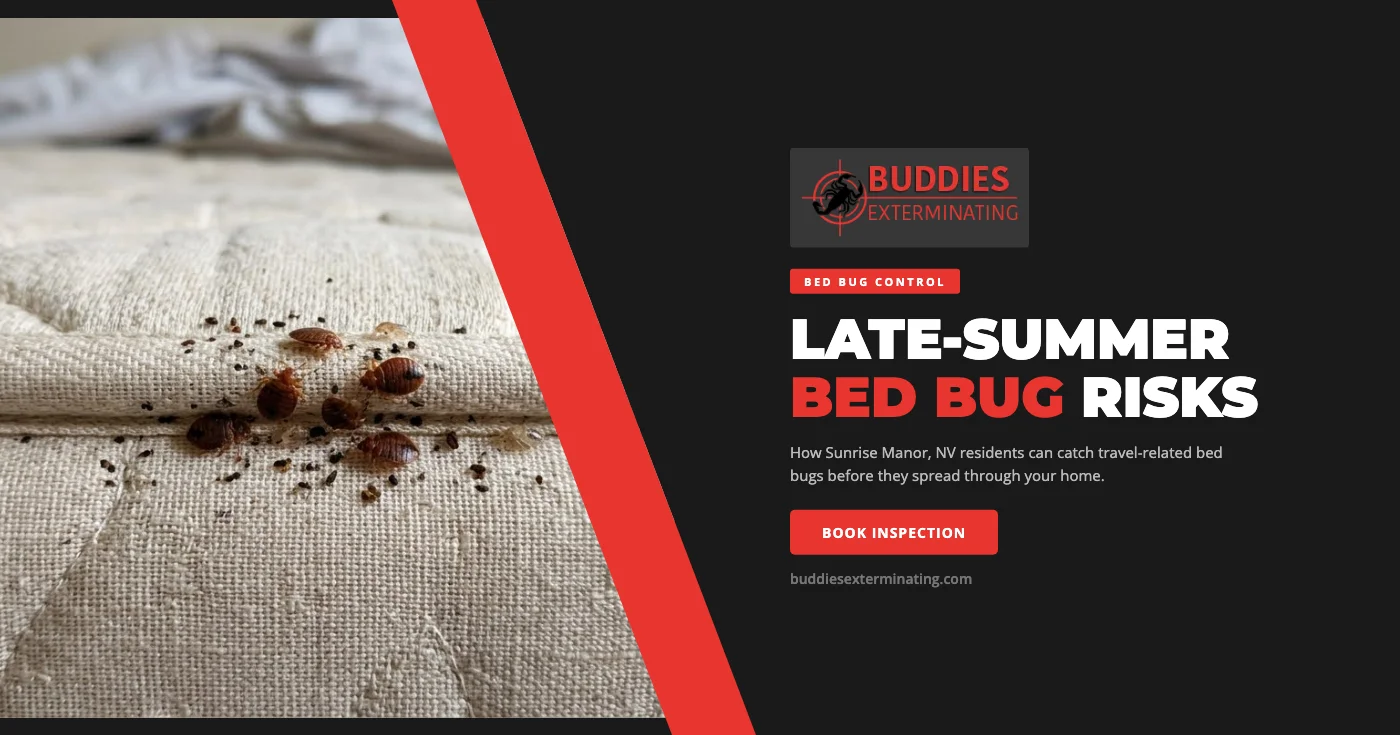
Sunrise Manor sits in the northeast corner of the Las Vegas Valley — pressed against Sunrise Mountain, wrapped around the south and west sides of Nellis Air Force Base, and full of neighborhoods that see a heavy summer travel rhythm. At Buddies Exterminating, our late-summer service calls tell a consistent story: a family returns from a long vacation, welcomes cousins for a Labor Day visit, or absorbs a PCS move from another base — and within a few weeks, welts appear at night and dark spots turn up on the mattress seam. This guide is a walkthrough of what bed bug control Sunrise Manor NV homeowners should know coming out of peak travel season, from how travel actually spreads the pest to why hardware-store sprays rarely finish the job.
The late-summer surge is not a coincidence. From mid-July through mid-September, Las Vegas travel volume peaks, Nellis-adjacent zip codes cycle through incoming PCS families, and the last big vacation window of the year sends suitcases in and out of northeast valley bedrooms every week.
How Late-Summer Travel Spreads Bed Bugs in Sunrise Manor, NV
Bed bug pressure tracks travel, and travel pressure in this part of the valley stays elevated well past Labor Day. Nellis Air Force Base cycles thousands of service members and dependents through PCS orders every summer — every incoming household unpacks belongings that have moved through a hotel, a temporary lodging facility, or a moving-company warehouse in the previous ninety days. Add returning vacationers, out-of-town family visits stretching into Labor Day, and the last waves of summer travel through the Las Vegas Strip corridor, and the pathways stack up quickly.
Once bed bugs enter a home, indoor climate does the rest. The Centers for Disease Control and Prevention classifies bed bugs as a public health pest, and reproduction accelerates in exactly the conditions Nevada bedrooms hold all summer. A single fertilized female lays roughly five eggs a day, eggs hatch in four to twelve days, and nymphs move through five feeding stages before adulthood. Between January 2024 and July 2026, the Southern Nevada Health District received more than 80 bed bug complaints and confirmed cases at multiple Strip properties — a signal that source populations remain active in the corridor northeast valley families move through.
Top Warning Signs of a Bed Bug Infestation in Your Home
Bites are the sign most people notice first — and the least reliable. Reactions vary widely, some people never develop a visible welt, and bed bug bites are routinely misidentified as mosquito bites, spider bites, or allergic rashes. Physical evidence around the sleeping area is far more dependable:
- Reddish-brown stains on sheets and pillowcases. Crushed bugs and blood residue, often clustered near mattress seams and the edges of a fitted sheet.
- Dark fecal spots. Bed bug droppings look like tiny black or dark-brown dots the size of a marker point, and they bleed into fabric. Check mattress piping, behind the headboard, along baseboards, and inside upholstered furniture folds.
- Shed skins and eggshells. Pale translucent exoskeletons and one-millimeter white eggshells near a sleeping area confirm an active, reproducing population — not a one-time hitchhiker.
- A sweet, musty odor. Heavy infestations release a distinctive stale-sweet smell, most noticeable in a closed bedroom running the AC.
- Live bugs. Adults are reddish-brown, flat, and about the size of an apple seed. Bed bugs are nocturnal and expert hiders — one in the open usually means the harborage is already crowded.
Why Bed Bugs Are Harder to Detect Than You Think
Bed bugs are built to stay hidden. Their body is roughly the thickness of a credit card, which lets them wedge into gaps a business card slides into — mattress seams, screw holes, the crease behind an outlet plate, the underside of a dust cover. They feed for eight to ten minutes at night while the host is asleep, then retreat several feet back to harborage before daylight.
The biology compounds the problem. Early nymphs are pale, translucent, and roughly the size of a poppy seed — trivially easy to miss on white bedding. Eggs are one millimeter long, cemented under a protective coating, and often laid in the tightest cracks rather than on the mattress surface. Most homeowners we work with find the first evidence somewhere around week five — enough time for a single hitchhiker to become dozens of feeding bugs with a full round of eggs already deposited in the room.
High-Risk Areas in Your Sunrise Manor Home to Inspect After Travel
Bed bugs almost never live inside the mattress they feed on — they live within a few feet of it, closest to where a returning traveler dropped their bag and slept the first night. When we inspect a Sunrise Manor home, we work in concentric rings out from the pillow:
- Mattress seams, piping, and the label. The tucked-in perimeter seam and the crease behind the sewn-in label are the first places we check.
- Box spring underside and fabric cover. Bed bugs often colonize corner staples and the underside dust cover before they touch the mattress itself.
- Bed frame joints and headboard. Wooden slats, screw holes, and the back of a wall-mounted headboard are classic harborage. Metal frames offer fewer sites, but bolt holes and welds still work.
- Nightstands, dressers, and luggage within six feet of the bed. Drawer runners, suitcase seams, wheel wells, and zipper folds are secondary harborage in nearly every established infestation.
- Baseboards, outlets, and wall cracks. Any gap the pest can compress into is worth a flashlight check — especially outlet plates behind the headboard, where bugs migrate when a mattress is disturbed.
What to Do If You Confirm Bed Bugs: Calling a Professional
The first instinct after finding bed bugs is to strip the bed, spray something from the hardware store, and hope for the best. Every step of that instinct works against you — stripping the bedding scatters eggs into other rooms, hardware-store sprays drive the rest deeper into wall voids, and moving to a couch or guest room typically spreads the infestation to a second sleeping area within a week. The correct sequence is smaller than most people expect:
- Do not sleep in a different room. Bed bugs follow the CO₂ signature of a sleeping host. Vacating the bed while continuing to occupy the home simply moves the population to the new sleeping area.
- Seal the affected bedding and clothing. Everything porous within the room goes into sealed plastic bags for laundering on high heat — worn items and unworn items alike.
- Leave the mattress and furniture in place. Moving them out of the room without treatment spreads harborage into the rest of the home. Wait for the inspection.
- Do not use foggers or bug bombs. Total-release insecticides push bed bugs into wall voids and adjacent units, converting a single-bedroom problem into a whole-home problem.
- Call for a licensed inspection. A professional can confirm the introduction, map the harborage, and recommend treatment before a small population becomes a large one.
Professional Bed Bug Treatment Options: Heat, Chemical, and Combined
Modern bed bug work uses three treatment categories, chosen based on the size of the infestation and the layout of the home:
- Heat treatment. Peer-reviewed research places the thermal death point for bed bugs around 113°F, with 120°F or higher shortening exposure time to minutes. Professional heat treatments hold whole rooms — wall voids, mattress internals, and frame joints — at 120°F or above for several hours, killing every life stage including eggs. Space heaters and hair dryers cannot reach or hold those temperatures.
- Chemical treatment. A licensed technician applies labeled residual products into specific harborage sites — cracks, crevices, frame joints, and voids. Because bed bug populations across North America carry documented pyrethroid resistance, the chemical class used, the rotation, and the placement matter far more than the volume of product.
- Combined treatment. The most reliable approach for established infestations pairs targeted heat with a residual chemical placement — an immediate kill plus a residual that catches any egg hatching after the heat cycle ends. Follow-up visits are timed to the egg-hatch cycle so late hatchers are intercepted before they feed.
Preventing Future Bed Bug Infestations After Treatment
Post-treatment prevention is where a lot of families relax too early. The pest is gone, but every pathway that let it in the first time is still open. The U.S. Environmental Protection Agency publishes prevention guidance built around three principles — reduce clutter, block introductions, and interrupt reintroduction:
- Encase the mattress and box spring. A zippered, bed-bug-rated encasement traps any survivor and turns a mattress into a smooth inspection surface. Leave it on for at least a year.
- Treat luggage as suspect after every trip. Inspect on a hard porch or in the garage, not on a carpeted bedroom floor. Launder all clothing on the hottest cycle the fabric tolerates and dry on high heat for at least 30 minutes.
- Reduce clutter around the sleeping area. Bed bugs harbor in what they can hide in. Fewer stacked books, storage bins, and clothing piles within six feet of the bed means fewer places to establish.
- Screen incoming furniture. A used couch, mattress, box spring, or upholstered chair from a curb, Marketplace listing, or thrift store is one of the highest-risk reintroductions we see all year.
- Ask about the origin of hosted luggage. Guests are not the enemy, but their suitcases have been somewhere in the previous week. A simple laundering-on-arrival routine for the guest bedroom drops the odds of a reintroduction sharply.
Frequently Asked Questions About Bed Bug Control in Sunrise Manor, NV
How do I know if I brought bed bugs home from vacation in Sunrise Manor, NV?
Watch the sleeping area for three weeks after a trip. Check sheets and mattress seams every few days for reddish-brown stains, dark fecal dots, translucent shed skins, or live bugs. Bites can help but are not reliable on their own — physical evidence is. If you find any of the signs, isolate the bedroom and call for a professional inspection before the population establishes.
Can bed bugs come home from a PCS move or a temporary lodging stay?
Yes — this is one of the most common introductions we handle in the northeast valley. Temporary lodging facilities, extended-stay hotels, and moving-company warehouses cycle through hundreds of households a year, and a single fertilized female riding home in a suitcase seam or a piece of upholstered furniture is enough to seed an infestation. Unpacking on a hard floor and laundering everything on high heat before it enters the bedroom drops the risk substantially.
How fast can a small bed bug problem become a full infestation?
Fast. A single female lays roughly five eggs a day, eggs hatch in four to twelve days, and each of the five nymphal stages needs a blood meal to molt. A stowaway from late July can grow into hundreds of bugs by late September if nothing intervenes.
Buddies Exterminating: Sunrise Manor's Local Bed Bug Experts
Bed bug control Sunrise Manor NV families count on has to match how the pest actually behaves — travel introductions, PCS moves, harborage a spray never reaches, eggs a spray never kills, and a breeding cycle that punishes delay. Our approach starts with a thorough inspection of the sleeping areas and every high-probability harborage within six feet of the bed, then pairs targeted heat protocols or integrated treatment that reaches the wall voids, mattress internals, and frame joints where the population lives. Follow-up visits timed to the egg-hatch cycle intercept the second generation before it can feed, and adjacent rooms are treated when the evidence points to spread.
We handle bed bug work across Sunrise Manor, the Nellis corridor, and the broader Las Vegas Valley, alongside our full pest services lineup. If you have returned from a summer trip or hosted family through the Labor Day stretch and found reddish stains on the bedding or dark spots along a mattress seam, contact our team to schedule a bed bug inspection before a hitchhiker turns into an infestation.