
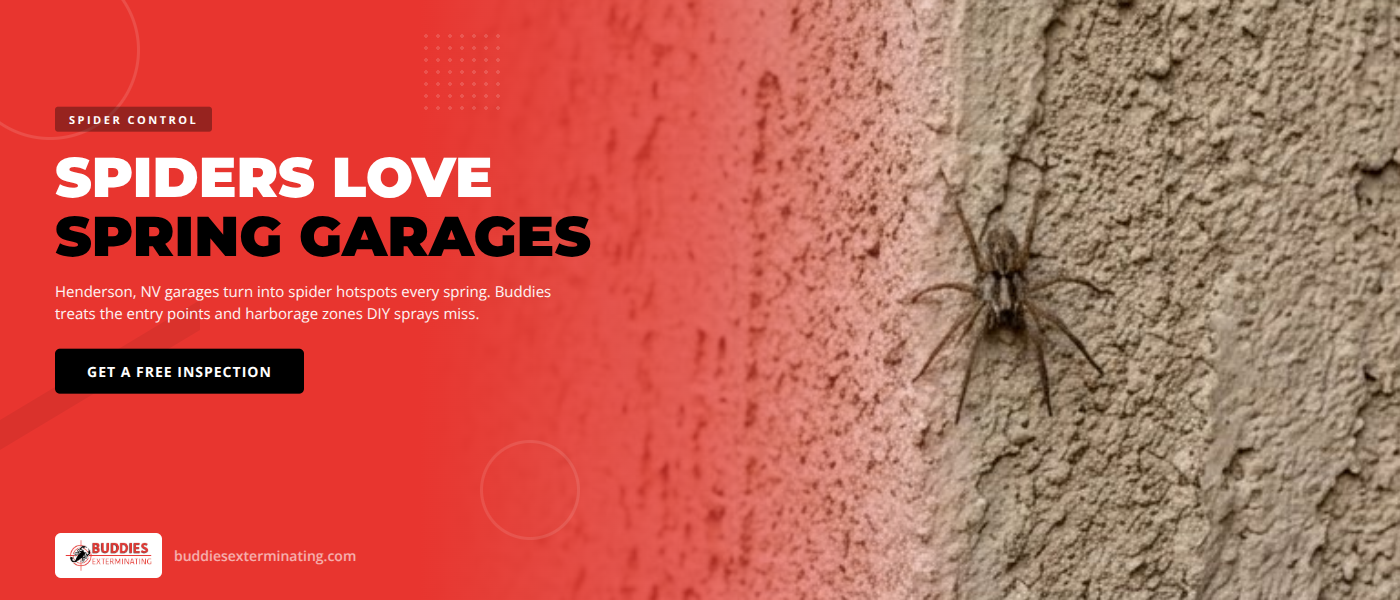
Every spring, we hear the same call from Henderson homeowners — "Why are there suddenly so many spiders in my garage?" If you've recently opened a storage bin, moved a box, or pulled out the patio cushions and found a fresh batch of webs, you're not alone. Spider control Henderson NV residents need most often spikes between March and June, and the reasons trace back to our desert climate. At Buddies Exterminating, we've spent years helping local families understand and resolve these seasonal infestations. In this guide, we'll walk through why spider activity surges each spring, which species you're most likely to encounter, and how to protect your home and family.
Most southern Nevada spiders are harmless — but a handful, particularly the western black widow, pose real risk to children, pets, and unsuspecting adults. Knowing the difference between an occasional visitor and a developing infestation matters.
Why Spring Triggers a Surge in Spider Activity Around Henderson, NV
Spring is prime time for spider activity throughout the Las Vegas Valley, and Henderson sits right in the middle of the action. As temperatures climb into the 70s and 80s, two things happen at once: spiders that sheltered through winter become active, and the insects they feed on — flies, moths, mosquitoes, and beetles — emerge in much larger numbers. More food means more spiders, and they go where the food is.
Spring is also breeding season. Egg sacs laid late in the previous year hatch as temperatures warm, releasing hundreds of spiderlings into garages, sheds, and yard spaces. According to the University of Nevada, Reno, a single female western black widow can produce multiple egg sacs containing hundreds of eggs each — which means even one undisturbed female in your garage corner can become a much larger problem within weeks.
Henderson's mix of new construction, established homes with mature landscaping, and proximity to open desert all add to the surge. Spiders that waited out the colder months in undisturbed corners, block walls, and stored items are suddenly mobile, hungry, and looking for new places to set up.
The Spiders Most Commonly Found in Henderson Garages and Sheds
Not every spider you spot in your garage is a threat — but knowing what's typical for the area helps you decide when to act. The species we most commonly identify during inspections in Henderson include:
- Western black widow. Glossy black with the iconic red hourglass on the underside, this is the species we treat most often in southern Nevada. They prefer dark, undisturbed spaces — exactly what a typical garage corner or stack of cardboard boxes offers.
- Wolf spiders. Large, hairy, and brown or gray, wolf spiders don't build webs — they actively hunt. Spotting one running across the floor is startling, but they're not aggressive and rarely bite unless cornered.
- Common house spiders. Small, brown, and harmless, these are responsible for the wispy webs in garage ceiling corners and behind shelving. Heavy populations indicate a strong food supply.
- Desert recluse. Less common in suburban Henderson than in surrounding desert, the desert recluse is tan to light-brown with a violin-shaped marking. Its bite can cause serious tissue damage.
- Cellar spiders. Long, thin-legged spiders that build messy webs in corners. Harmless, but their webs accumulate fast and trap dust.
Garages and sheds are spider magnets because they offer everything a spider needs: quiet corners, layered clutter, gaps under doors, and a steady supply of insects drawn in by exterior lighting. The longer a space goes undisturbed, the more attractive it becomes.
How Outdoor Lighting and Landscaping Attract Spiders to Your Home
Exterior lighting and landscaping choices are often the single biggest reason a property attracts spiders. Spiders don't seek out light — but the insects they eat absolutely do. Once a reliable food source sets up near your home, spiders follow and stay.
Standard white and bluish-spectrum porch lights are among the worst offenders. Moths, beetles, and flying insects cluster around those wavelengths all night long, and black widows and other web-builders quickly set up shop nearby — particularly in garage door frames, eaves, and patio overhangs. Switching to amber or yellow LED bulbs reduces insect attraction and, over time, spider activity in those zones.
Landscaping plays an equally important role. Dense shrubs planted against the foundation, woodpiles stored next to the house, and decorative rock features all provide ideal spider harborage. Henderson's popular block-wall fencing is another known issue — the gaps between blocks create thousands of tiny hiding spaces. Trimming vegetation back from the foundation, elevating woodpiles, and sealing block-wall gaps all reduce available habitat. Worn garage door weather-stripping is another open invitation — replacing damaged seals is one of the simplest, most cost-effective steps you can take.
Dangerous Spiders Henderson Families Should Watch For
Most spiders in Henderson pose little risk to people, but two species require real caution: the western black widow and the desert recluse. According to the U.S. Centers for Disease Control and Prevention, both species can deliver bites that require medical attention — and both are present in southern Nevada.
The western black widow's venom is neurotoxic. Symptoms typically begin within one to two hours of a bite and can include severe muscle cramping, abdominal pain, sweating, and elevated blood pressure. Children, older adults, and people with underlying conditions are at higher risk. Black widows are not aggressive — most bites happen when someone reaches into a web while moving stored items, putting on garden gloves left in the garage, or sliding a hand into an unused boot.
The desert recluse causes a different problem. Its venom can produce tissue necrosis — the area around the bite may become discolored, blistered, and ulcerated over the following days. Like the black widow, it hides in boxes, clothing on the floor, and rarely-used corners. If you suspect a bite, seek medical evaluation and, if possible, capture the spider in a sealed container for identification.
Signs You Have More Than the Occasional Visitor
Spotting one spider isn't necessarily cause for concern — but a few patterns indicate a developing infestation that needs attention:
- Multiple webs in the same area. One web in a garage corner is normal. Three or four overlapping webs, plus webs along nearby shelving, points to an active breeding population.
- Egg sacs. Black widow egg sacs are tan, papery, and roughly pea-sized. Even one means a female has nested. Eggs mean more spiders soon.
- Repeat sightings of the same species. Seeing wolf spiders or black widows weekly suggests they're breeding on your property, not passing through.
- Spider activity moving indoors. When spiders appear in living spaces, bedrooms, or laundry rooms — not just the garage — the population has grown beyond what the perimeter can absorb.
The earlier you act, the easier the fix. A small population can usually be managed with targeted treatment and a few preventive adjustments. A heavy infestation built up over months requires a more comprehensive approach.
Effective Spider-Proofing Steps for Henderson Homeowners
Reducing spider activity around your home doesn't require an extreme overhaul — but it does take consistent attention to a few key areas:
Seal entry points. Inspect the perimeter for cracks in the stucco, gaps around window frames, and openings where utility lines enter. Caulk any gap larger than a credit card. Pay extra attention to the garage door seal and pet doors.
Reduce clutter in storage areas. Replace cardboard boxes with sealed plastic bins, store items off the floor on shelving, and leave space between items so the area can be cleaned periodically.
Manage exterior lighting. Switch white porch and patio lights to amber or yellow LEDs. Where possible, position lights away from doorways so insects (and the spiders that follow them) aren't drawn to entry points.
Trim back vegetation. Keep shrubs, trees, and ornamental plants from touching the exterior. A 12-to-18-inch buffer between landscaping and the foundation makes it harder for spiders to bridge from yard to structure.
Address insect populations. A strong spider population is also a sign of a strong insect population. Treating the underlying pest issue often does more to reduce spiders than treating the spiders directly. We offer full-perimeter residential pest control programs that address both at once.
Inspect before reaching. When pulling out boxes, gloves, boots, or anything that's been sitting undisturbed, give it a quick visual check first. This single habit prevents most accidental black widow encounters.
When to Call Buddies Exterminating for Professional Spider Control
Some spider situations call for professional intervention, and recognizing them early protects your family and saves you money in the long run. Reach out to us if you've noticed any of the following:
- Confirmed sightings of black widow or desert recluse spiders on your property.
- Multiple egg sacs or web clusters in the garage, shed, eaves, or block-wall fencing.
- Spider activity that's persisted or grown despite your own DIY efforts.
- Indoor sightings beyond the occasional cellar spider in a corner.
- Anyone in your household who has been bitten and needed medical attention.
Our team provides thorough perimeter inspections, targeted treatment, and ongoing prevention programs designed for the conditions Henderson and the wider Las Vegas Valley actually face. We treat every property as unique — adjusting for the age of the home, the surrounding landscape, the type of fencing, and the species we identify during the inspection. We also handle related Nevada pests including scorpions, cockroaches, and rodents, which often share the same harborage areas as spiders.
If you've been searching for reliable spider control in Henderson, NV, we'd be glad to help. Contact Buddies Exterminating to schedule an inspection and get a treatment plan built around your home.
Frequently Asked Questions About Spider Control in Henderson, NV
Why are spiders worse in Henderson during spring?
Spring brings warmer temperatures, hatching egg sacs, and an explosion in insect activity — all of which drive more spider sightings. Garages, sheds, and yard spaces that sat undisturbed through winter become active hubs as spiders emerge to hunt and breed.
How do I tell a black widow from other Henderson spiders?
Adult female western black widows are jet-black, glossy, and roughly the size of a dime, with a distinctive red hourglass on the underside of the abdomen. They're almost always found in webs in undisturbed corners, woodpiles, or block-wall gaps. If you're unsure, don't handle the spider — capture it carefully or photograph it from a distance for professional identification.
Are spiders in my Henderson garage dangerous to pets?
Most are not, but black widow and desert recluse bites can cause serious reactions in dogs and cats. Pets often investigate spiders with their noses or paws, so the risk of accidental contact is real. Reducing harborage areas in the garage and yard significantly lowers the chance of a pet encounter.
Will store-bought sprays handle a black widow problem?
Generally, no. Hardware-store sprays may kill spiders on direct contact but don't reach the egg sacs and harborage spots where most of the population lives. Black widows in particular tend to remain in protected web sites that consumer products can't penetrate. Professional treatment targets the full lifecycle and the structural conditions that allow it to continue.
How long does professional spider control take to work?
Most homeowners notice a significant drop in spider activity within the first one to two weeks of our initial treatment. Lasting results require a combination of treatment, structural adjustments, and a follow-up plan tied to seasonal activity. We'll outline what to expect when we walk the property with you.
Protecting Your Henderson Home from Spiders Year-Round
Spider activity in Henderson is seasonal, but it's manageable with the right combination of professional treatment and homeowner awareness. The earlier you address an emerging problem, the easier it is to resolve. Whether you've spotted a black widow in the garage or you're trying to get ahead of the spring surge, we're here to help. Contact our team to schedule an inspection and protect your home and your family's well-being throughout the season.