
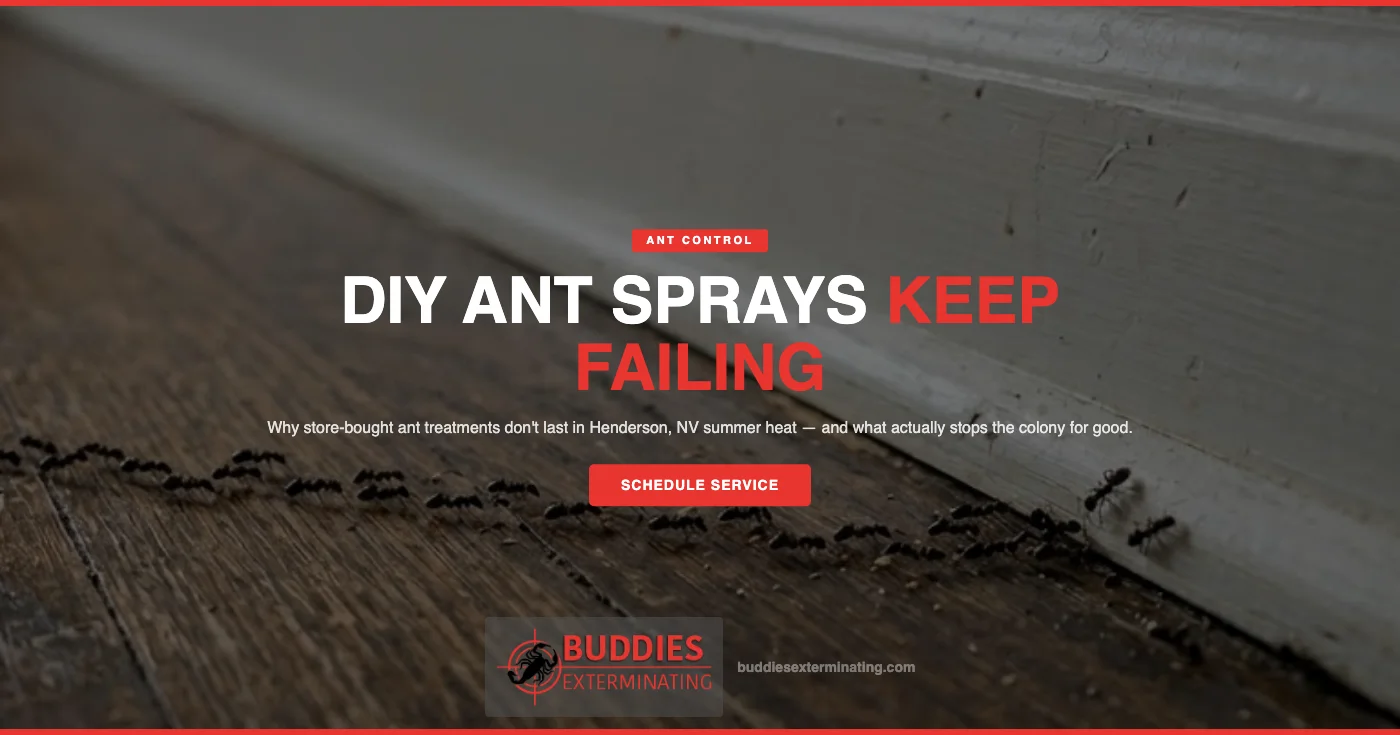
Every June in Henderson, NV, the same call pattern hits our line. A homeowner sprayed a counter trail two weeks ago, watched the ants vanish, and now there are twice as many in three rooms. At Buddies Exterminating, we see this cycle so consistently we can predict the next call before the phone rings. DIY ant sprays are not just ineffective in our desert climate — they often make the problem materially worse. Below is what changes once Henderson summer locks in, why retail products fail, and what actually breaks the cycle for ant control Henderson NV homeowners can count on.
Why Ant Activity Surges in Henderson Once Summer Heat Sets In
Henderson sits at the southeastern edge of the Las Vegas Valley. Summer highs run from the upper 90s into the 110°F range, with relative humidity routinely dropping below 15%. By mid-June, the desert outside is physiologically hostile to almost every ant species in the valley — and that is exactly when the indoor sightings climb.
Three forces converge to push ants toward your home:
- Water becomes the limiting resource. Irrigated landscaping, pool decks, condensation under HVAC lines, and leaky hose bibs are the most reliable water sources for miles. Ants follow water before they follow food.
- Surface temperatures turn lethal. Block walls and pavers routinely measure 140°F or hotter at midday. Foraging shifts to dawn, dusk, and overnight, and colonies expand satellite nests toward shaded foundations and wall voids.
- The food supply moves with them. Crumbs, pet food, and uncovered fruit are higher-value targets than anything they can scavenge outside in 110°F heat.
Colonies that quietly lived in irrigation valve boxes, mulch beds, and block-wall weep gaps through spring concentrate around your foundation and push scouts inside through stucco gaps, weep holes, plumbing penetrations, and worn door sweeps. By the time you see the trail, the colony has already mapped your kitchen.
The Critical Mistake: Spraying What You See Instead of the Colony
The most common DIY mistake we correct in Henderson kitchens is the most intuitive one: you see ants, so you spray ants. The aerosol kills the visible foragers within seconds, the trail vanishes, and the problem feels solved — for about a week.
The ants you see represent roughly 1% to 5% of the colony. The queen, the brood, and the egg-laying infrastructure are all underground, inside a wall void, or tucked into an irrigation box twenty feet from your kitchen. Surface spray never touches them. The colony replaces the dead foragers within days, often along a slightly different trail to avoid the residue.
We routinely walk into Henderson homes where the homeowner has emptied two cans of ant spray, the trails keep returning, and the population has visibly expanded into rooms it wasn't in three weeks ago. The treatment did exactly what the label promised — and the infestation kept growing because the colony was never the target.
How Desert Heat and UV Break Down Store-Bought Ant Sprays
Even when a DIY product is applied outside, Henderson's summer environment degrades it faster than the label assumes. Most consumer ant sprays rely on pyrethroid active ingredients — bifenthrin, permethrin, cypermethrin — formulated for residual activity of several weeks to a few months under moderate conditions.
Mojave summer is not moderate. Three forces shorten that residual sharply:
- UV photodegradation. Pyrethroids break down under direct sunlight. On a south- or west-facing Henderson foundation in July, the label's "up to three months" can collapse to a matter of days.
- Surface temperature volatilization. Active ingredient on a 140°F block wall evaporates off the treated surface far faster than the formulation was designed for.
- Irrigation washoff. Drip and spray irrigation hits the same foundation perimeter that homeowners treat. A single overnight watering cycle moves residue off the surface within the first 24 hours.
The treatment that looked effective in the first two days is effectively gone by the time the next foraging wave hits the foundation. The ants do not learn to avoid the spray — there is simply nothing left to avoid.
Species That Outsmart DIY Treatments in Henderson Homes
Effective ant control begins with correct species identification, and the Henderson homes we treat all summer share a short list of indoor ant species — most of which are structurally resistant to the way consumer products work.
- Argentine ants (Linepithema humile). The dominant nuisance ant across the Las Vegas Valley. Argentine colonies form supercolonies with multiple queens across dozens of interconnected satellite nests, so killing one nest accomplishes almost nothing. According to the University of California Statewide IPM Program, repellent sprays are particularly ineffective against Argentine ants because the colony simply reroutes around the treated zone.
- Odorous house ants (Tapinoma sessile). Small, dark, and prone to "budding" — splitting into new colonies under stress. A repellent spray is one of the most reliable ways to turn one nest into four.
- Pavement ants (Tetramorium spp.). Nest under slabs, sidewalks, and patio pavers — surface spray never reaches the actual nest.
- Carpenter ants (Camponotus spp.). Large and quietly damaging. They tunnel into moisture-compromised framing around windows, roof penetrations, and irrigation overspray zones. A trail spray does nothing about the structural damage in the wall void.
Every one of these species responds best to correct identification, non-repellent residual chemistry, and targeted baiting that workers carry back to the queen. None respond well to a can of aerosol in the kitchen.
Why Repellent Sprays Cause Colonies to Split and Spread
The most damaging dynamic in DIY ant control across Henderson is colony budding — a predictable consequence of repellent insecticides.
Most over-the-counter ant sprays are repellent by design. The active ingredient signals "danger" before it kills, and the colony responds in two ways. Foraging workers stop crossing the treated zone, so the visible trail disappears and the homeowner reads that as success. More importantly, the stress signal travels back to the nest. Multi-queen colonies — Argentine, odorous house, and certain pavement ant populations — respond by splitting. One or more queens leave with workers and brood and establish a new satellite nest where the chemical signal does not reach.
In a Henderson yard with block walls, irrigation boxes, and mulch beds, that "somewhere else" is rarely more than ten or twenty feet away. The homeowner who started with one trail in the kitchen is now dealing with three — kitchen, bathroom, and laundry — each fed by a separate satellite nest from the same original colony. The retail spray did exactly what its chemistry was designed to do; the infestation got worse because the response it triggered is the colony's defense mechanism, not its failure mode.
What Professional Ant Baiting and Treatment Does Differently
Professional ant control built for Henderson summers solves the colony problem, not the visible-ant problem. Our approach pairs species identification with two chemical strategies the consumer aisle does not offer: non-repellent residuals and slow-acting baits.
- Non-repellent residuals. Modern professional formulations — built around active ingredients like fipronil and certain neonicotinoids — do not signal "danger" to foraging ants. Workers walk through the treated zone, pick up the active on their bodies, and carry it back to the nest, where it transfers to nestmates and the queen through grooming and trophallaxis. The colony collapses from the inside out without ever triggering the budding response.
- Slow-acting baits matched to the species. Argentine ants prefer sweet baits year-round; carpenter ants and odorous house ants shift seasonally between sugar and protein. Effective baits use slow-acting toxicants — boric acid at 0.5–1%, hydramethylnon, fipronil, indoxacarb — so workers feed multiple times and recruit the rest of the colony before any visible mortality begins. UC IPM emphasizes that bait concentration matters: too strong and the bait itself becomes repellent, defeating the entire mechanism.
- Targeted exterior perimeter work. We treat the foundation, irrigation valve boxes, block-wall weep gaps, and the shaded harborage along the slab — the actual nesting and staging areas, not the kitchen counter.
- Structural exclusion. Worn door sweeps, unsealed plumbing penetrations, weep holes without screens, and cracked stucco around hose bibs are the entry points we close as we treat. Without exclusion, the next wave walks right back in.
Accurate species ID, non-repellent chemistry, matched baiting, and physical exclusion produce what no retail product can: a colony-level collapse and an exterior that does not refill the empty habitat within a month.
When to Call Buddies Exterminating for Lasting Ant Control
An occasional scout ant on a Henderson counter in summer is normal. Professional ant control stops being optional when the population stops being incidental. Book an inspection when you notice any of the following:
- Defined trails — not single scouts — appearing in two or more rooms within a single week.
- Ants returning within days of a thorough cleanup or DIY treatment.
- New trails forming in rooms that were ant-free a month ago — a strong indicator of colony budding from earlier spraying.
- Wood damage, sawdust-like frass, or hollow-sounding framing near windows or roof penetrations — possible carpenter ant activity.
- Heavy ant activity around HVAC condensate lines, water heaters, or under-sink cabinets, which signals an established interior moisture-driven nest.
Our Henderson program pairs species identification with non-repellent residual treatment, baiting matched to the species, exterior perimeter work along block walls and irrigation infrastructure, and structural exclusion. We handle related pests on the same visit, including cockroaches and spiders that share the same harborage.
Frequently Asked Questions About Ant Control in Henderson, NV
Why do the ants come back a week after I spray?
The ants you sprayed were 1% to 5% of the colony — the disposable foragers. The queen and brood were never touched, and the colony simply produced replacements and rerouted around the treated zone.
Will vinegar, peppermint oil, or cinnamon get rid of ants permanently?
Home remedies disrupt the pheromone trail workers follow, so the visible trail breaks up for a few days. The colony is unaffected, new scouts find a new path within a week, and the trail reforms. Repellents move ants around; they do not eliminate colonies.
How is professional ant treatment different from what I buy at the store?
We use non-repellent chemistry that workers carry back to the nest without alarming the colony — store products are repellent by design. We also match bait active ingredients and bait type to the species in your home, with concentrations calibrated so the bait is attractive long enough for workers to recruit the whole colony.
Are professional ant treatments suitable for homes with children and pets?
The products we use are professional-grade formulations applied as targeted residuals into harborage and structural pressure points — not broadcast across living surfaces. We design every plan with families and pets in mind and walk every Henderson homeowner through the specific products on the visit.
How long does it take for professional ant treatment to work?
Surface activity often drops noticeably within 48 to 72 hours. Full colony collapse — including the queen — typically takes two to three weeks because the bait and non-repellent residual are designed to work slowly enough that the entire colony is exposed before any visible die-off begins.
Stop the Ant Cycle in Your Henderson Home This Summer
The Henderson summer makes ant pressure predictable. The species are known, the harborage zones are mapped, and the failure pattern of DIY sprays repeats every year — visible trails disappear, hidden colonies grow, and the homeowner ends up with a bigger problem than they started with. Homeowners who stay ahead of it skip the aerosol and put a professional plan on the calendar before June heat compounds into the July population spike.
If you have a returning trail, a new one in a second or third room, or a yard you suspect is feeding the colony, contact our team to schedule an inspection. We will identify the species, treat the colony rather than the symptom, and keep the next wave outside through the rest of the Henderson summer.