
North Las Vegas homeowners deal with termite pressure that most other parts of the country simply don't face. The combination of desert-adapted termite species, the Las Vegas Valley's clay-rich soil profile, and the relentless summer heat creates conditions where termites remain active year-round — with no cold winter season to slow them down. If you haven't had your home inspected recently, or if you've noticed any of the warning signs described below, summer is the time to pay close attention.
At Buddies Exterminating, we provide professional termite control in North Las Vegas, NV and throughout Clark County. We understand how termites behave in the Las Vegas Valley specifically — and what it takes to protect homes built on the caliche and clay soils common in North Las Vegas neighborhoods.
Why North Las Vegas Homes Are Vulnerable to Termites Year-Round
In most parts of the United States, termite activity slows significantly during cold winter months. Soil temperatures drop, termite colonies retreat deeper underground, and swarming activity stops entirely until spring. The Las Vegas Valley doesn't follow this pattern.
Clark County's mild winters — with average low temperatures that rarely drop below 35°F even in December — allow desert subterranean termite colonies to remain active year-round at or near the soil surface. Termites can access the root systems of landscaping plants, wooden fencing, railroad-tie retaining walls, and the structural wood in your home's foundation continuously, without the seasonal pause that limits termite activity in colder climates.
North Las Vegas soil composition contributes to this vulnerability. The valley's soils contain significant clay and caliche layers that retain moisture far longer than sandy desert soils in other regions. This retained moisture supports termite colony hydration even during the driest months, allowing colonies to forage more broadly without relocating to find water sources.
New construction in North Las Vegas — particularly in areas like Aliante, Eldorado, and the surrounding master-planned communities — involves significant soil disturbance that can disrupt existing termite colonies, causing them to forage unpredictably. Homes built in recently developed areas may face particularly active termite pressure from displaced colonies searching for new food sources.
Summer Termite Activity in the Las Vegas Valley — What to Expect
While North Las Vegas termites are active all year, summer brings specific changes in behavior that make infestations more likely to be noticed — and more important to address promptly.
Desert subterranean termites and Arid-land subterranean termites, the two species most common in Clark County, both swarm during summer months. Swarming is the process by which a mature colony produces winged reproductives called alates that emerge to mate and establish new colonies. In the Las Vegas Valley, swarming typically occurs during warm evenings following any rain event — including the monsoon rains that reach the valley from late July through August.
Finding large numbers of winged insects — resembling flying ants but with equal-length wings and no pinched waist — near windows, exterior lights, or around your foundation after a storm is the most visible summer sign that termite colonies are active near or beneath your home.
Summer heat also pushes termites to seek moisture more aggressively. Homes with drip irrigation systems, pool equipment, HVAC condensate lines, or plumbing leaks near the foundation are particularly attractive targets during the hottest months, as these moisture sources provide what termites need to sustain colony growth during dry periods between rains.
Top Warning Signs of a Termite Infestation in Your Home
Most termite damage in North Las Vegas homes occurs hidden inside walls, below floors, and within structural framing — areas that aren't visible without tools or expertise. However, termites do leave detectable evidence on surfaces homeowners can observe without specialized equipment.
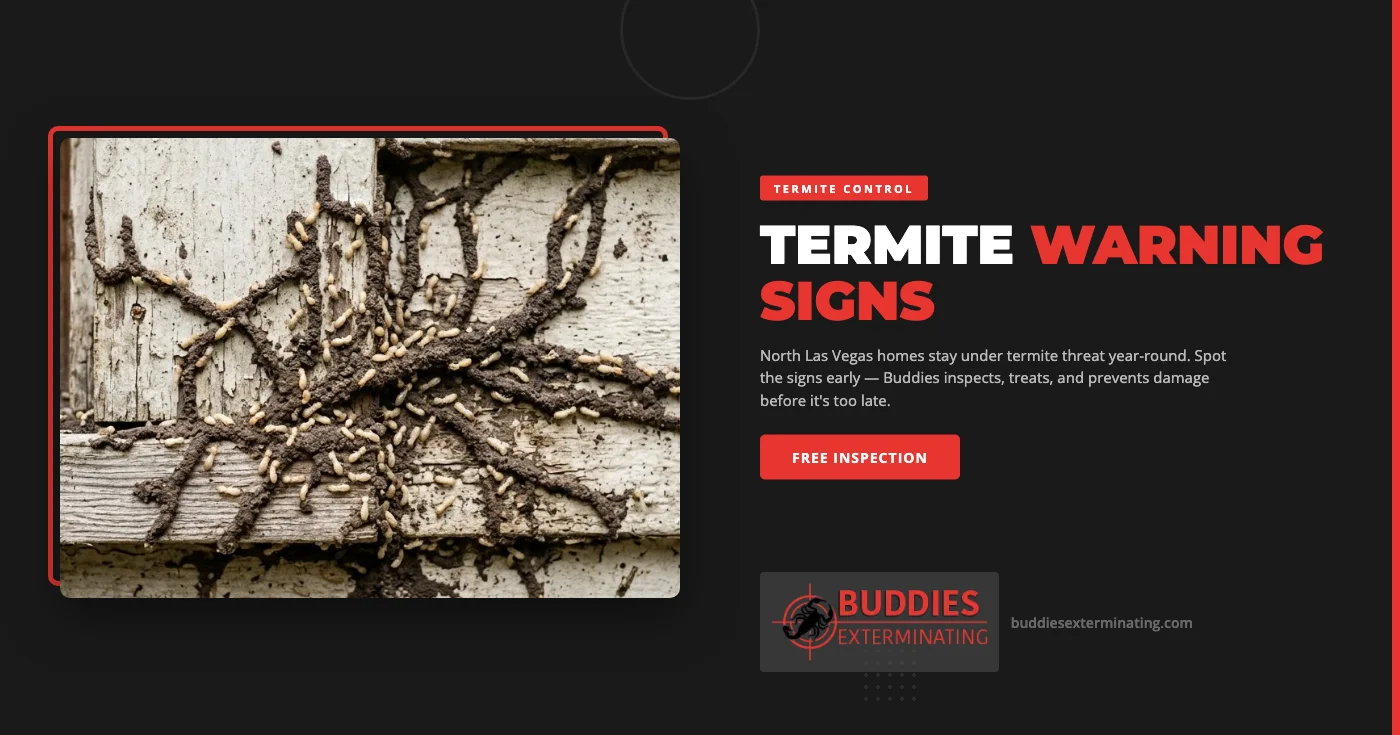
Mud tubes on exterior surfaces — Subterranean termites build pencil-width tunnels made from soil, saliva, and termite excrement to travel from the soil to above-ground wood sources. These mud tubes are most commonly found on foundation walls, block fencing, and stucco surfaces close to grade. They may also appear on interior walls in basements or crawl spaces. Breaking open a mud tube and finding live termites confirms active infestation; a dry, empty tube suggests previous activity that may or may not be current.
Swarmers or discarded wings — As described above, finding swarmers or the shed wings of swarmers near windows, doors, or light fixtures is a strong indicator that a colony is mature and producing reproductives. Swarmers themselves don't damage wood — but the colonies they emerge from are actively feeding.
Hollow-sounding or damaged wood — Subterranean termites consume wood from the inside out, leaving a thin shell of intact surface while hollow galleries are created within. Tapping door frames, window sills, baseboards, and wood trim and listening for a hollow sound can reveal termite damage in locations where the surface appears normal. Paint that bubbles, blisters, or peels in wood-framed areas may indicate moisture trapped by termite activity behind it.
Tight-fitting doors or sagging floors — As termites damage structural framing, subtle changes in the structure can cause previously well-fitting doors and windows to stick or warp. Floor surfaces that develop a soft or spongy feel underfoot may have sustained damage to the subfloor or floor joist system beneath.
Frass (drywood termite feces) — Drywood termites are less common in North Las Vegas than subterranean species but are present in the valley. Drywood termites produce hard, hexagonal fecal pellets that they push out of kick-out holes in infested wood. Finding small piles of fine, sandy pellets on horizontal surfaces below window frames, baseboards, or attic structures indicates drywood termite activity.
Subterranean vs. Drywood Termites: What's in North Las Vegas?
Both termite types are present in Clark County, though subterranean species cause the majority of structural damage in North Las Vegas.
Desert subterranean termites and Arid-land subterranean termites maintain large underground colonies that can extend 50 to 100 feet from the main nest. Workers forage outward through the soil and construct mud tubes to access above-ground cellulose. These colonies are capable of causing significant structural damage — in active infestations, structural members can be hollowed out over a period of months without visible surface evidence.
Drywood termites in Clark County are most commonly found in older homes, in attics with exposed wood framing, and in wood window and door components exposed to exterior conditions. Unlike subterranean termites, drywood species require no soil contact and live entirely within the wood they consume. Infestations progress more slowly than subterranean infestations but can be more difficult to locate because there are no mud tubes to identify their presence.
Treatment differs significantly between the two types. Subterranean termites are typically addressed through soil-applied termiticides or bait station systems. Drywood termites require direct wood treatment, heat treatment, or fumigation depending on the extent and location of the infestation. Accurate species identification is the first step in selecting the appropriate approach.
How Buddies Exterminating Treats and Prevents Termite Damage
Effective termite treatment in North Las Vegas requires an approach tailored to the specific species, the construction type of your home, and the extent of existing damage. At Buddies Exterminating, we begin every termite service with a thorough inspection to establish exactly what we're dealing with before recommending treatment.
For subterranean termites, our treatment options include liquid termiticide application and professional bait station programs. Liquid termiticides applied in trenches around the foundation create a continuous chemical zone in the soil that termites either avoid or contact and transfer back to the colony. Non-repellent termiticide formulations are particularly effective because they allow termites to move through the treated zone and share the active ingredient throughout the colony, resulting in more complete elimination than repellent-only products.
Bait station systems are placed in the soil around the perimeter of the home at regular intervals. When termites discover and begin feeding on the bait matrix, they carry it back to the colony. The active ingredient disrupts the termite molting cycle, gradually reducing the worker population and affecting the queen's reproductive output. Bait stations require regular monitoring and refilling as termites consume the matrix.
For drywood termite infestations, we assess whether localized treatment — applied directly to infested wood — or broader intervention is appropriate based on the scope of the infestation and the areas affected.
Following treatment, we provide a detailed report of what was found, what was done, and recommendations for monitoring going forward. For properties with high ongoing termite pressure, we offer annual inspection programs to detect new activity early.
Schedule a Termite Inspection in North Las Vegas Today
The best time to address termite pressure in North Las Vegas is before visible damage appears — and before a small colony expands into a larger infestation. A professional termite inspection gives you a baseline understanding of the termite activity around your property and identifies any evidence of existing damage that should be monitored or addressed.
If you're seeing any of the warning signs described in this article — mud tubes, swarmers, hollow-sounding wood, frass, or structural changes — schedule a professional inspection as soon as possible. Active termite infestations don't resolve on their own, and the damage they cause is not covered by standard homeowners insurance policies.
Contact Buddies Exterminating for termite control in North Las Vegas, NV and throughout Clark County. We serve North Las Vegas, Las Vegas, Henderson, and the surrounding communities with inspections and treatment programs designed for the Las Vegas Valley's specific termite pressure.