
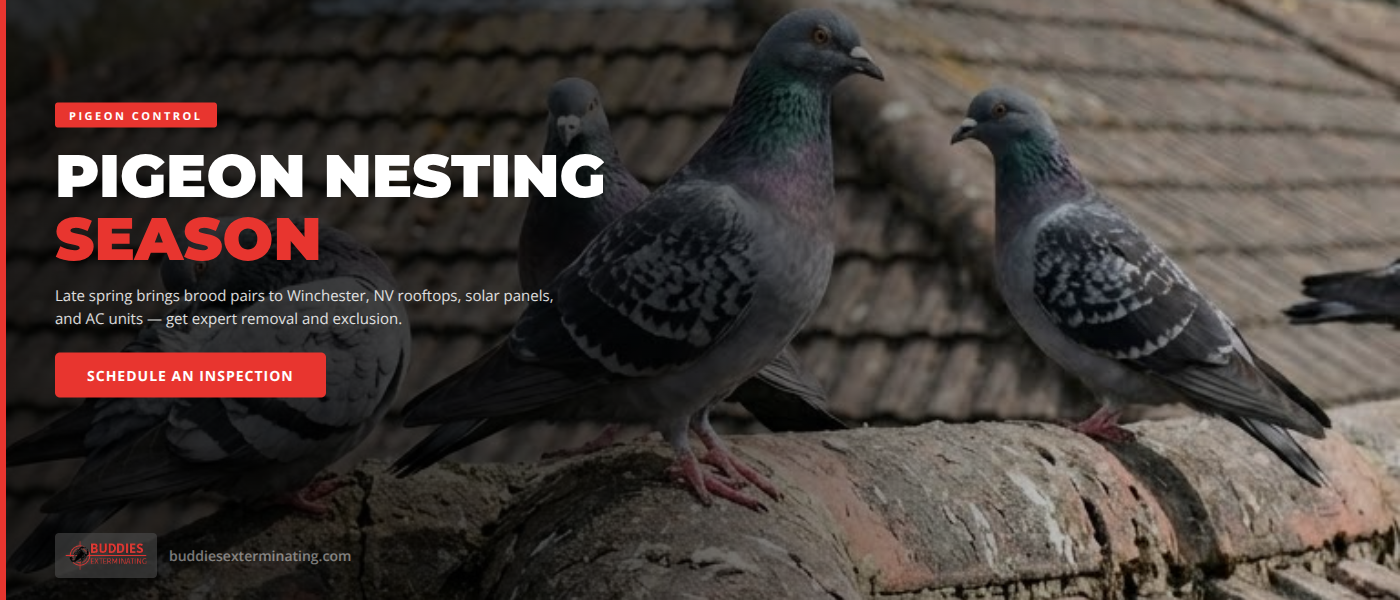
By late May in Winchester, NV, attic temperatures are past 120 and a familiar pair of birds is fanning out across the central Las Vegas Valley looking for a place to raise a brood. We see the same pattern at Buddies Exterminating every spring — feral pigeons (Columba livia) pair off and slip under solar arrays, behind parapet walls, and onto rooftop AC platforms in numbers that catch first-time homeowners off guard. The pigeon control Winchester NV homes need right now is not seasonal cleanup; it is exclusion before nesting locks in. This guide covers what is driving the spring push and the prevention work that keeps the next brood pair from settling in.
Why Late Spring Drives Pigeon Nesting in Winchester Neighborhoods
Winchester is the central Vegas Valley township pressed between Paradise, the Strip corridor, and east Vegas — a mix of apartment courts, mid-century single-family blocks, and a growing patchwork of rooftop solar. Three local conditions converge in late spring to make Winchester a pigeon nesting magnet.
- Year-round breeding with a spring surge. Vegas Valley pigeons breed nearly year-round, but warmer mornings extend daylight foraging and pair-bonded adults begin claiming territory in earnest. By Memorial Day weekend most Winchester pigeons are on a second or third brood of the calendar year.
- Dense rooftop solar. Winchester rooftops carry more solar than the average Vegas Valley neighborhood thanks to past-decade incentive cycles. The 3-to-6-inch gap between panel and roof gives a nesting pair the one thing the open desert never offers — a shaded, predator-free, climate-buffered cavity sized exactly for their bodies.
- Mature street trees and block walls. Ficus, palm, and oleander combined with block-wall capstones give brood pairs the roosting and lookout perches they need within easy flight of any rooftop array.
By the time you spot a pair circling your eave repeatedly, they have already picked their site and started gathering twigs.
How Pigeons Choose Roofs, Solar Panels, and AC Units for Brood Pairs
The answer comes down to shade, shelter, and a stable thermal microclimate. Pigeons evolved on Mediterranean and North African cliff ledges — to a pigeon, a Winchester roof is a cliff with bonus features: wind blocks, overnight warmth, and a 360-degree view of approaching threats. Three rooftop surfaces draw the heaviest pressure:
- Solar arrays. The gap beneath the panels is the single most attractive nesting cavity in modern Vegas Valley construction — a cool, predator-free bunker exactly the cavity feral pigeons are wired to claim.
- Rooftop and ground-mounted AC condensers. Condensers throw waste heat and offer flat ledges and shaded cabinet voids. Residential coil cabinets, pad-mounted package units, and commercial RTUs in Winchester all see nesting attempts.
- Parapet walls, soffits, and tile fields. Spanish-tile roofs with open eave gaps and flat-roof buildings with HVAC ductwork up top are prime real estate.
Once a pair commits, both birds carry twigs and landscape material in for 4 to 7 days before the female lays. Eggs hatch in roughly 18 days, squabs fledge in another 4 to 6 weeks, and one undisturbed pair turns into a multi-generation colony before the homeowner notices.
The Damage Pigeon Droppings Cause to Vegas Valley Homes
The two questions homeowners ask first are about the noise and the mess. Both matter, but the more expensive problem is what the droppings do over time. Pigeon guano is acidic — pH typically between 3 and 4 — and that acidity is what drives most of the structural damage we document on Winchester roofs.
- Roofing material breakdown. Acidic droppings corrode underlayment, eat through asphalt shingle granules, and discolor tile glazing. A heavily used roost can begin compromising waterproofing in a single nesting season.
- Solar efficiency losses. Droppings on panel surfaces have been documented to reduce energy generation by as much as 30 percent until cleaned, and nesting debris beneath the array blocks rear-side airflow.
- Wire and electrical damage. Pigeons under solar arrays gnaw DC wiring, peck conduit clips, and pull insulation for nesting material. Damaged wiring plus dry nesting debris under a hot array is also documented as an ignition risk in solar fire investigations.
- AC unit corrosion and airflow restriction. Droppings on a condenser coil corrode aluminum fins, restrict airflow, and shorten compressor life. Pigeons nesting inside a package unit can directly clog blower wheels and filters.
- Stucco, paint, and tile staining. One nesting season can leave permanent staining down a stucco wall or tile fascia that requires power-washing and recoating to resolve.
Most homeowners we work with discover this damage during a routine roof or solar inspection — by which point the repair cost is already built in.
Health Risks of Pigeon Nests Near Living Spaces
This is the section we wish more Winchester homeowners read before deciding to wait and see. Pigeon droppings carry pathogens that become aerosolized once the guano dries — and roofs, attics, and AC intakes are exactly the surfaces where dried droppings get stirred up and pulled into living space.
- Histoplasmosis. A respiratory fungal infection caused by Histoplasma capsulatum, which grows in soil enriched by bird droppings. The CDC documents that HVAC technicians, roofers, demolition workers, and maintenance staff have all become ill from disturbing accumulated bird droppings without protective equipment. The Mayo Clinic notes that histoplasmosis usually presents with flu-like symptoms but can progress to severe lung disease in vulnerable patients.
- Cryptococcosis and psittacosis. A yeast infection (Cryptococcus neoformans) from aging droppings and a bacterial infection transmitted by inhaling dried droppings or feather dust — both carry elevated risk for immunocompromised residents.
- Ectoparasites. Pigeon mites, bird ticks, and bird lice migrate off the nest once squabs leave or the parents abandon — and a Winchester attic full of mites finds its way into bedrooms.
The pathway that matters most for Winchester homes is the rooftop AC unit. Droppings near a package unit or fresh-air intake get drawn into the airstream, dried, broken down, and circulated through the home — a far bigger indoor air quality problem than the visual mess on the roof suggests.
Why DIY Spikes and Scarecrows Rarely Work in Winchester
Most Winchester homeowners try one of three DIY fixes before calling us — usually after spending a few hundred dollars at the hardware store and finding nothing has changed. A few reasons the DIY approach stalls out:
- Plastic owls and reflective scarecrows. Pigeons habituate to stationary visual deterrents within days. By the second week the owl is just another perch.
- Hardware-store spikes installed in the wrong places. Spikes on the parapet do nothing if the pigeons are already under the solar array. Worse, spikes installed without cleanup trap nesting debris and droppings underneath where they cannot be removed.
- Cleanup without exclusion. Pressure-washing a roost without sealing the cavity simply gives the returning pair a clean site. The same pair often re-nests within 10 days.
- Untensioned bird wire. Bird wire that sags or is mounted with too few stanchions becomes a perch instead of a deterrent.
- Ultrasonic and predator-call devices. Sound deterrents have not shown durable results against feral pigeons in independent testing or homeowner reviews. The birds adapt.
The pattern repeats: a homeowner spends $200 to $600 on DIY products, the pigeons return inside a month, and the damage continues to accumulate while the situation looks handled.
Exclusion Methods That Actually Keep Pigeons Off Your Property
Long-term pigeon control on a Winchester property is a physical exclusion problem first and a population problem second. If pigeons cannot land, perch, or access nesting cavities, the property stops being a nesting site — and the surrounding pigeon population eventually moves on. The exclusion measures that hold up in the Vegas Valley climate:
- PVC-coated stainless steel solar mesh. Installed perimeter to perimeter on every accessible array. Industry guidance recommends mesh at least 8 inches tall, mounted with stainless clips that attach to the panel frame without drilling. Coated steel is essential — uncoated mesh rusts and stains stucco within a single Vegas summer.
- Tensioned stainless bird wire. Run along parapet walls, ridges, and the highest perch points. Properly tensioned wire is nearly invisible from the ground and stops landing without harming the bird.
- Stainless or polycarbonate spikes. Installed on ledges narrower than 6 inches, and only after thorough sanitization.
- Bird netting. Suited to covered patios, equipment cages, and any unfinished structural cavity birds have begun to claim.
- Rooftop AC unit screening. Stainless screening on package-unit intakes, condenser cabinet base gaps, and any pigeon-accessible coil compartment.
- Cleanup and sanitization first. Every exclusion job starts with full removal of nesting material, dropping cleanup, and disinfectant treatment using respirators and protective equipment to manage the histoplasmosis exposure described above. Skipping this step traps contaminated material in place permanently.
The goal is to make the property uninteresting before the next breeding pair scouts it — not to chase the current pair.
How Buddies Exterminating Handles Pigeon Removal and Prevention
A pigeon job on a Winchester property is rarely a single visit. Our standard workflow:
- A site walk and roof inspection covering solar arrays, AC platforms, parapet walls, soffits, and visible droppings concentration. We document where nesting is active, historic, and most likely next.
- Humane removal of active nests and birds where legally permitted, with timing that respects fledgling stages on already-laid eggs.
- Full sanitization of contaminated surfaces — droppings, nesting material, and disinfection — performed with appropriate respirators and disposal.
- Custom exclusion: solar mesh fitted to the array geometry on the home, bird wire on the perch lines that matter, AC screening, and sealing of any cavity drawing nesting pressure.
- A follow-up inspection 4 to 6 weeks after installation, plus seasonal monitoring during the peak nesting window.
For Winchester property owners with related pest pressure — ants tracking up wall lines, cockroaches drawn by dropping debris, or rodents sharing the same shaded cavities under panels — we handle the related work on the same visit. One well-timed exclusion project resolves the pigeon problem and prevents the secondary infestations that almost always follow a long-running roost.
Frequently Asked Questions About Pigeon Control in Winchester, NV
Are the pigeons on my Winchester roof legal to remove?
Feral rock pigeons (Columba livia) are not protected under the Migratory Bird Treaty Act, so removal is generally permitted in Nevada. We still recommend timing the work to avoid disturbing eggs or unfledged squabs whenever possible — that lines up with humane practice and keeps the project clean from a public-relations standpoint.
How long does it take pigeons to come back after a roof cleaning?
Without exclusion, a pair often re-nests at the same site inside 10 days, particularly under solar arrays. With proper mesh and bird wire installed at cleanup, return rates drop to near zero.
Will solar panel mesh void my system warranty?
Most reputable installers approve frame-mounted clips because they attach without drilling the panel itself. We confirm warranty compatibility before installation on every Winchester project.
Can I clean pigeon droppings off my own roof?
We strongly advise against it. Dried droppings aerosolize the moment they are disturbed, and the histoplasmosis and cryptococcosis pathway documented by the CDC and Mayo Clinic is real for untrained workers. That exposure is exactly why we treat sanitization as a respirator-and-protective-equipment job.
How long does a pigeon exclusion project take in Winchester?
Most single-family Winchester homes take one full day for cleanup and exclusion. Larger properties with two arrays or commercial rooftop units take 2 to 3 days. We schedule cleanup and exclusion as one continuous project so contaminated material is never left exposed overnight.
Protect Your Winchester Property Before Pigeon Pressure Locks In
The spring nesting window in Winchester is short, and once a brood pair claims a site the damage and contamination accumulate every week. Solar arrays, AC units, and rooftop ledges are the high-risk surfaces this time of year, and exclusion installed early — before the second brood — is the difference between a one-time project and a recurring problem. Contact our team to schedule a roof and pigeon control inspection.