
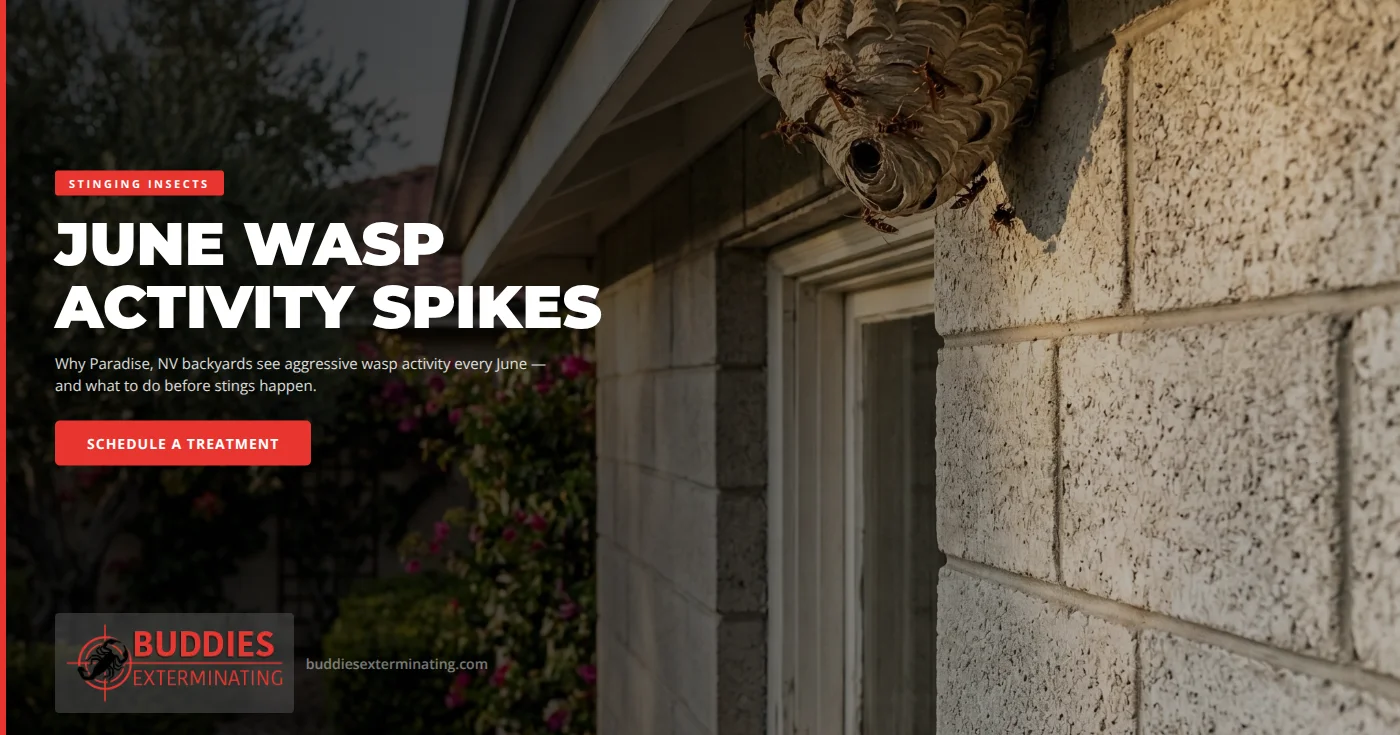
Every June in Paradise, NV, the same call pattern lights up our phones. A homeowner steps out the back slider for morning coffee, ducks past a paper-wasp scout, and a week later a fist-sized cone of grey paper is tucked under the awning — and the colony inside has stopped tolerating anyone within ten feet of the door. At Buddies Exterminating, we provide the wasp control Paradise NV homeowners count on through summer. June is when the calendar tips from manageable spring nests into the defensive colonies that drive most stings across the Las Vegas Valley. This guide covers what changes in June, where Paradise wasps build, why DIY removal backfires, and the prevention work that keeps colonies from rebuilding next year.
Why June Triggers a Wasp Activity Spike in Paradise, NV
Paper wasp and yellowjacket colonies follow a strict annual clock. An overwintered queen emerges in March or April, builds a starter nest of a dozen cells, and raises the first generation of workers. Through May the nest is quiet and easy to miss. Then June arrives — worker numbers enter exponential growth, the queen focuses on laying, and the nest expands to grapefruit-sized in weeks.
Three local factors compress that timeline in Paradise:
- Daytime highs locked in by Memorial Day. Once afternoons clear 95°F, foraging shifts to the cooler dawn and dusk windows — the same hours Paradise families use the patio.
- Reliable backyard water. Pools, drip-irrigation drip-points, pet bowls, and evaporative-cooler bleed lines supply the moisture a colony needs to thermoregulate.
- Year-round food. Hummingbird feeders, fallen citrus and palm dates, exposed pet food, and BBQ residue keep workers fed long after natural prey thins out.
According to the UC Statewide IPM pest note on paper wasps and yellowjackets, desert-Southwest colonies become reliably aggressive once worker counts cross roughly 100 — a threshold most Paradise nests cross during June.
Common Stinging Insects Found Around Paradise Homes
Not every flying stinger in a Paradise backyard is the same animal, and the treatment plan changes based on what you're dealing with. Honey bees in particular are protected pollinators we relocate rather than exterminate.
- Paper wasps (Polistes spp.). Slender body, dangling legs in flight, rust-to-brown coloring. Open umbrella-shaped paper nests hanging from a single stalk under eaves, patio covers, and grill housings.
- Western yellowjackets (Vespula pensylvanica). Stocky, bright yellow-and-black scavengers around food and sugary drinks. They nest in ground cavities, block-wall voids, and irrigation boxes — far more dangerous to disturb than open paper-wasp nests.
- Mud daubers. Thread-waisted, metallic-blue solitary wasps that build small tubular mud nests on walls. Rarely sting, mostly beneficial — leave them alone.
- Honey bees. Fuzzy, golden-brown, traveling in repeatable lines to a single point on a wall, tree, or attic vent. A steady column through one spot is a colony, not a wasp problem — we handle it as live removal.
Anyone searching for a bee wasp exterminator las vegas needs a service that can tell these apart on sight — a wrong call on a honey-bee colony causes thousands of dollars in damage when abandoned wax and honey melt down inside the wall.
Where Wasps Build Nests on Backyard Patios and Eaves
Paradise's backyard architecture — open patio covers, block-wall fencing, stucco eaves — gives wasps a rich menu of nesting sites. The recurring hot spots we map on inspections:
- Patio-cover and pergola joists. Shaded, structural, rarely brushed — paper wasps favor the inside face of the perimeter beam.
- Stucco eaves and soffit returns. Inside corners where eaves meet wall give wind protection and a single-stalk attachment point.
- BBQ housings and grill covers. A grill untouched for two weeks in May reliably has a nest by June.
- Outdoor light fixtures. Shaded by day, warmed at night, shielded from sprinkler overspray.
- Block-wall weep holes. Yellowjackets live inside the wall and exit through a single hole.
- Irrigation valve boxes. Cool, dark, reliably damp, and hidden under a lid until you open it.
Mapping these locations is the first step on any Paradise wasp control visit. Spraying a visible nest without finding the cavity entry points sets up a recurring problem next month.
Why Summer Wasps Are More Aggressive Than Spring Ones
The aggression gap between an April nest and a late-June nest is dramatic, and it's entirely a function of colony size and pheromone signaling. A spring nest with five to fifteen cells has no guards and no alarm response — bumping it produces one annoyed wasp, not a coordinated attack. By June, the same colony has dozens to hundreds of workers, a guard rotation, and an alarm pheromone that recruits the whole colony in seconds.
Three things change when a Paradise colony crosses that threshold:
- Multi-sting envenomation becomes likely. A single paper wasp can sting repeatedly; an alarmed yellowjacket colony delivers dozens of stings in under a minute — with anaphylaxis risk for sensitized individuals.
- Defensive radius expands. A spring nest must be touched to trigger a response. A June nest engages anyone within ten to fifteen feet, especially in morning and evening foraging windows.
- Vibrations trigger attacks. Mowers, weed trimmers, and pressure washers near a ground-nesting yellowjacket colony reliably trigger mass-sting events. CDC occupational data places landscaping among the highest-risk professions for fatal stinging-insect incidents — the same physics applies to homeowner yard work.
The Real Dangers of DIY Wasp Nest Removal
The worst sting cases we hear about in Paradise start the same way: a homeowner grabs a hardware-store aerosol, hits a nest at the wrong time of day, and gets a partial knockdown that leaves an angry colony intact. The failure modes are predictable:
- Daytime treatment misses most of the colony. Half the workers are out foraging — returning workers regroup, rebuild, or start satellite nests nearby.
- Cavity nests soak the surface but never reach the colony. Yellowjackets in a block wall are protected from contact spray. The weep-hole is just the doorway; the nest may be three feet inside.
- The queen survives a wasp-spray hit on the comb. A queen tucked deep in the brood section often survives an exterior knockdown, and the surviving workers rebuild around her within days.
- Ladder falls compound the risk. Most DIY attempts happen at dusk on an eight-foot ladder against stucco. A homeowner with two wasps inside their shirt is not a stable ladder operator.
- Ground-nest disturbance triggers mass-sting events. Boiling water or gasoline poured into a yellowjacket ground nest sends hundreds of survivors into the air and creates hazards around children and pets.
For nests larger than a golf ball, anything in a wall cavity, anything near children's play areas, or any household with a known sting allergy, professional paradise nv wasp removal is the right call from the start.
Backyard Prevention Steps Every Paradise Homeowner Should Take
Prevention work from February through April is the highest-leverage pest-control habit in southern Nevada. Catching a queen-only nest in spring is a five-second task; clearing a 200-worker colony in June is a service visit. The habits that matter most for Paradise yards:
- Walk the eaves weekly in March and April. Quarter-sized starter nests are visible if you look. A long-handled brush takes them down in seconds.
- Seal soffit returns and attic-vent gaps. Caulk hairline gaps where stucco meets fascia and screen ridge and gable vents.
- Cap block-wall weep holes with stainless mesh. Eliminates the most common yellowjacket cavity-nesting site in Paradise — and keeps scorpions out at the same time.
- Cut off the easy water. Repair drip-irrigation leaks, fix pool autofills, bring pet bowls inside overnight, and check evaporative-cooler bleed lines.
- Move hummingbird feeders 25 to 30 feet from the patio. Serves the hummingbirds, stops being a wasp magnet around dining areas.
- Clear fallen citrus and palm-date drop. Rotting fruit is the biggest yellowjacket attractant in established Paradise yards.
- Trim vegetation 12 to 18 inches back from the structure. Vegetation touching the wall is a vertical bridge past ground-level barriers.
A Paradise yard with these habits is not wasp-free, but the odds shift dramatically — fewer nests start, the ones that do are caught early, and the food and water draws around the patio largely disappear.
How Buddies Exterminating Handles Wasp and Bee Removal
Our wasp and bee program for Paradise homes pairs accurate species ID with treatment timing matched to the biology of the colony. A typical visit includes:
- Walk-through identification. We confirm whether it's paper wasps, yellowjackets, mud daubers, or honey bees before choosing a treatment path. Honey bees go to live removal.
- Dawn or dusk treatment. Workers concentrate on the nest during low-light hours, so one application reaches the full colony — not just the foragers out at midday.
- Cavity treatment for void-nesting yellowjackets. A dust formulation pushed through the entrance — workers carry it deep into the colony, clearing the queen and brood we can't reach directly.
- Nest and comb removal. An abandoned paper-wasp nest invites the next queen to rebuild on the same scent trail next spring. Removing the comb breaks that cycle.
- Exclusion follow-up. Sealing the entry point — weep-hole capping, soffit caulking, vent screening — is the difference between a one-time clear and a recurring annual problem.
For summer wasp nest removal nevada work — from a single paper-wasp nest to a multi-cavity yellowjacket problem in a block wall — Buddies Exterminating wasp control is built around Las Vegas Valley seasonal patterns rather than a national playbook. Our work pairs naturally with our spider control and scorpion control visits, since the same harborage patterns drive multiple Paradise pest problems at once. Learn more about our bees and wasps control program.
Frequently Asked Questions About Wasp Control in Paradise, NV
Why are wasps so aggressive in June in Las Vegas?
By June, paper-wasp and yellowjacket colonies have grown from a single queen in April to hundreds of workers, with a guard rotation and a chemical alarm response. The same nest that was non-reactive in May will defend a ten- to fifteen-foot radius by mid-June — not because the wasps are angrier, but because more of them are organized to defend.
What attracts wasps to my patio in summer?
Three things, in order: water (drip-irrigation leaks, pool spillover, pet bowls), sugary food (hummingbird-feeder nectar, fallen fruit, soda cans), and protein (BBQ grease, pet food, outdoor scraps). Yellowjackets shift from hunting caterpillars in spring to scavenging human food in mid-summer, which is why patio cookouts become wasp magnets in June and July.
Should I try to take down a wasp nest myself?
For a quarter-sized nest in March or April with a lone queen, yes — a quick brush-down at dusk solves it. For anything golf-ball-sized or larger after Memorial Day, anything inside a wall cavity, anything within reach of children or pets, or any household with a sting allergy, the risk of a partial knockdown outweighs the cost of a service call.
How do I tell a honey-bee colony from a wasp nest?
Honey bees fly in steady columns to and from a single point on a wall, tree hollow, or attic vent. Paper wasps build a visible grey papery nest hanging from a stalk; yellowjackets exit a hole in irregular patterns. A steady processional traffic pattern is a honey-bee colony — call for live removal rather than spraying.
How fast can a wasp nest grow once I notice it?
In the Paradise heat curve, a paper-wasp nest visible at fist-size in early June is typically grapefruit-sized by month's end and at peak worker counts by mid-July. The window between "I should do something" and "this is a defensive colony" is two to three weeks once daytime highs hold above 95°F.
Protect Your Paradise Backyard Before Wasp Season Peaks
The June wasp curve in Paradise is predictable, and so is the prevention plan that works against it. Habitat reduction, structural sealing, early-spring nest checks, and a properly timed professional wasp control Paradise NV service turn a stressful annual problem into a manageable one — and keep families on the patio through the best summer evenings. Contact our team to schedule an inspection.