
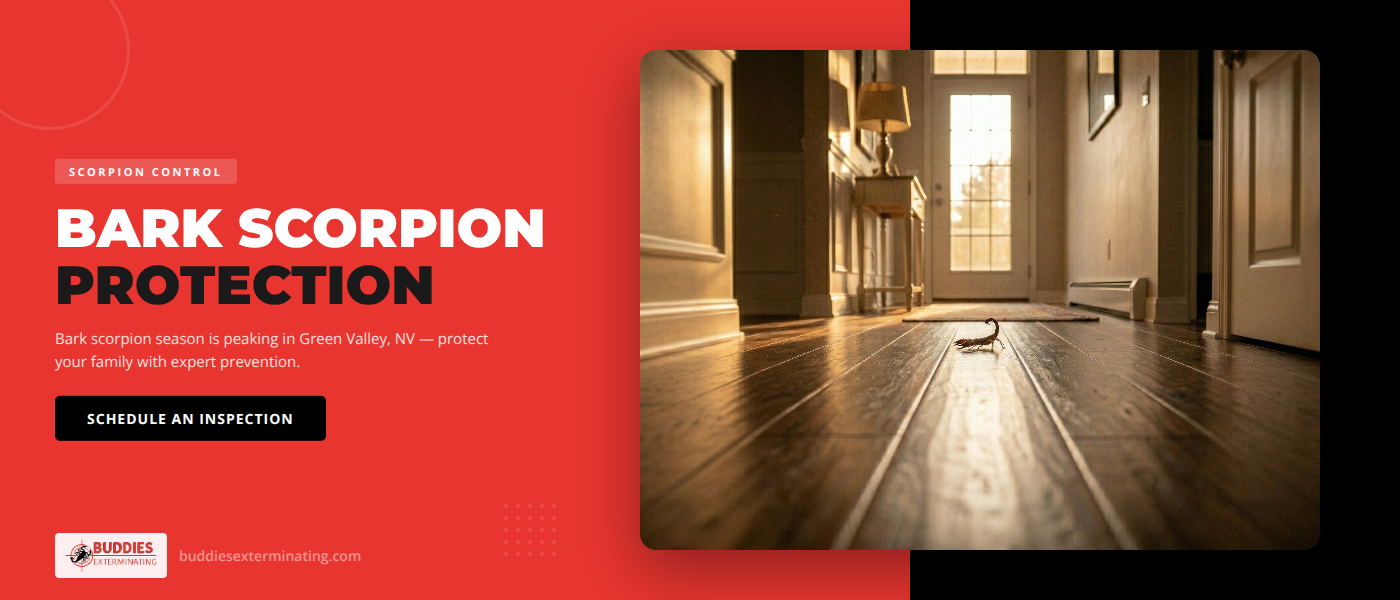
Every May, the calls start coming in. A parent in Green Valley hears their kindergartener cry out in the middle of the night, flips on the lights, and finds a pale tan scorpion clinging to a baseboard. Bark scorpions are part of the Las Vegas Valley desert ecosystem, and Green Valley's master-planned neighborhoods sit right inside their preferred habitat — irrigated yards, block-wall perimeters, and warm summer evenings. At Buddies Exterminating, we walk Green Valley homes through the bark scorpion control Green Valley NV families need most, especially the ones with young children or anyone who has had a previous reaction to insect venom. This guide covers species ID, nighttime UV sweeps, and the structural fixes that keep stingers outside where they belong.
Why May and June Are Peak Bark Scorpion Months in Green Valley
Bark scorpions are cold-blooded and almost entirely nocturnal, and their activity tracks closely with nighttime temperature and humidity. By early May in Green Valley, overnight lows climb into the upper 60s and 70s — exactly the range that pulls scorpions out of their winter harborages and back into active hunting mode. June ramps that up further, and by the time monsoon moisture arrives, populations are at full strength across the south Las Vegas Valley.
Three local factors make Green Valley especially attractive to bark scorpions:
- Mature irrigated landscaping. Decades-old palms, oleander hedges, and turf zones hold the soil moisture that scorpions and their cricket prey both need to survive the summer.
- Block-wall property fencing. Nearly every Green Valley yard shares a block wall with a neighbor. The hollow cells, open weep holes, and rough mortar joints are textbook bark scorpion harborage.
- Stone and decomposed-granite landscaping. Sun-warmed rock by day, cool refuge by night — exactly what a nocturnal predator looks for.
According to the Arizona State Parks scorpion field guide, this same warm-season activity pattern holds across the bark scorpion's range throughout the Mojave and Sonoran deserts.
How to Identify a Bark Scorpion vs. Other Desert Scorpions
Knowing what you're looking at matters because the bark scorpion (Centruroides sculpturatus) is the only scorpion in southern Nevada whose sting can produce serious systemic symptoms — particularly in young children. Two other species you'll occasionally find in Green Valley homes are far less concerning medically.
- Bark scorpion. Slender body, 2 to 3 inches long, pale tan to yellowish, thin pincers, and a long thin tail. The diagnostic feature is body proportions — narrow pincers and a tail longer than the body. They climb readily: walls, shower curtains, hanging towels, and the underside of palm fronds are all fair game.
- Desert hairy scorpion. Much larger — 4 to 6 inches — with a tan body, dark back stripe, and obvious hair on the tail. Despite the size, the sting is closer to a wasp's. They do not climb vertical surfaces well.
- Stripe-tailed scorpion. Stocky build, 2 to 3 inches, darker brown with visible tail stripes. Stays low; painful sting but not medically dangerous.
The fastest field test in a dark room is a UV blacklight — every scorpion species fluoresces bright green-cyan under 365 nm UV. If you see a slim glowing form clinging to a vertical surface above ground level, treat it as a bark scorpion until proven otherwise.
Where Bark Scorpions Hide Around Green Valley, NV Homes
Bark scorpions need three things to thrive: harborage that buffers temperature extremes, access to moisture, and a steady supply of crickets, roaches, and other soft-bodied insects. Green Valley homes hand them all three. During our exterior inspections, the recurring hot spots are:
- Block-wall weep holes and capstones. Open weeps at the base of perimeter walls and gaps under loose capstones are the single most common harborage in Green Valley. We've watched a dozen scorpions emerge from one wall section during a single UV sweep.
- Irrigation valve boxes and meter pits. Cool, dark, reliably damp, and almost never inspected.
- Palm trees and palm-skirt debris. Decorative palms with un-trimmed lower fronds are scorpion condominiums — daytime shade, climbing access, and prey insects in one structure.
- Stacked yard items. Firewood, pavers, plant pots, pool toys, and patio cushions on the ground become harborage within a week.
- Garage clutter and stored boxes. Cardboard, seasonal decorations, and stacked totes give scorpions everything they need to settle in.
- Indoors: bathrooms, laundry rooms, and any room with plumbing. Bark scorpions follow moisture indoors, and shower stalls and laundry-room floors are common night-time encounters.
Mapping these harborages is the first thing we do on any Green Valley scorpion service call — without locating the harborage, treatment is just spraying the symptoms.
Family Protection Tips: Protecting Children From Scorpion Stings
Stings from bark scorpions are most concerning in children under six, who are smaller in body mass and more likely to develop neurotoxic symptoms — uncontrolled muscle movements, blurred vision, slurred speech, or breathing difficulty. A handful of habits sharply reduce the chance of a Green Valley child encountering one.
- Shake out shoes, towels, and bedding before use. Especially shoes left in a garage or by a back door overnight. This single habit prevents more pediatric stings than any other.
- Pull beds away from walls and skip dust ruffles. Bark scorpions climb, but they don't drop down from the ceiling. Keeping bedding off the floor and frames off the wall eliminates the bridge into the sleep zone.
- Use night lights and check before walking barefoot. A small overnight light in hallways and bathrooms gives kids a chance to spot a scorpion before stepping on it.
- Do a UV blacklight sweep before bedtime in peak season. A $15 hardware-store UV flashlight makes the entire bedroom, bathroom, and child's play area scannable in five minutes.
- Know the medical response. Any sting on a child under six, or any sting that produces neuromuscular symptoms in someone of any age, warrants a call to Poison Control or a trip to the nearest emergency department. According to the New England Journal of Medicine, targeted antivenom treatment in pediatric patients with severe envenomation resolves symptoms within hours, so prompt evaluation matters.
For a child with asthma, a previous severe insect-sting reaction, or a pre-existing respiratory condition, treat a bark scorpion sting as a medical emergency rather than waiting to see how symptoms develop.
What to Do If You Find a Bark Scorpion Inside Your Home
The instinct to step on it is understandable — and the wrong move. Bark scorpions are surprisingly quick, and a missed strike sends them under a baseboard or appliance where they reappear days later in a less convenient spot.
The better approach:
- Trap, don't crush. Invert a clear glass over the scorpion, slide stiff cardboard underneath, and you have containment that lets you photograph the body for ID and dispose of it outside.
- Mark the spot. Most indoor scorpions enter from the same gap night after night, and that location tells us where to focus exclusion work.
- Don't reach blindly into closets, attics, or storage. Use a flashlight or headlamp, and shake out clothing before handling.
- Check siblings' rooms and pet beds. If one bark scorpion got past the perimeter, there are usually others nearby.
If you find one indoors and have small children at home, a same-week service visit is the right move rather than waiting for the next monthly cycle.
Sealing Entry Points and Yard Habits That Keep Scorpions Out
Exclusion is the single highest-leverage piece of bark scorpion prevention. Treatment chemistries have a real role, but a scorpion that can't physically get inside never becomes a problem in the first place.
Around the house:
- Install or replace door sweeps on every exterior door, including the garage walk-through. Bark scorpions can flatten through a gap thinner than a credit card.
- Caulk around plumbing, gas, and electrical penetrations. Sink-base, dishwasher, and water-heater closet penetrations are common indoor entry points.
- Repair stucco cracks and reseal weep screeds at the foundation. Hairline gaps along the bottom of the stucco are entry highways for scorpions and crickets alike.
- Replace damaged window screens and reseal slider tracks. Worn weatherstripping is a direct path from a block wall onto a bedroom carpet.
In the yard:
- Trim plants 12 to 18 inches back from the foundation. Vegetation touching the wall is a vertical bridge that bypasses every ground-level barrier.
- Pull back rock and mulch from the foundation. Aim for a clean buffer strip of bare soil or hardscape against the wall.
- Cap or screen block-wall weep holes with fine mesh. This eliminates the most common single harborage in Green Valley fence lines.
- Clear yard clutter weekly. Firewood off the ground and stored on a rack, pool toys put away, planter pots stored upright on a shelf rather than on the patio.
- Knock down the cricket population. Crickets are the primary bark scorpion food source. Reducing exterior lighting, switching porch bulbs to yellow LED, and keeping garage doors closed at night dramatically lowers the prey base.
A Green Valley property that does all of these is rarely an attractive scorpion environment, even at peak summer pressure.
When to Call a Local Green Valley Scorpion Exterminator
If you've found bark scorpions inside the home, have young children or vulnerable family members, or have a property with mature landscaping and block walls (which describes most of Green Valley), professional service is the most reliable layer of protection. A Buddies Exterminating scorpion control program for Green Valley typically includes:
- A daylight harborage inspection covering the structure, block walls, palms, and irrigation features.
- An after-dark UV blacklight sweep to map active populations.
- Targeted perimeter treatment with products selected for the waxy desert exoskeleton of bark scorpions — most general-purpose sprays are largely ignored by them.
- Recommended exclusion work and a follow-up service cycle timed to the local peak season.
We also routinely handle other Las Vegas Valley pests that share scorpion harborage — spiders, cockroaches, and ants — on the same visit, so a single service often clears multiple problems at once.
Frequently Asked Questions About Bark Scorpion Control in Green Valley, NV
How can I tell whether a sting was from a bark scorpion?
Bark scorpion stings typically produce sharp localized pain, a tingling or numbness that radiates from the sting site, and sometimes pins-and-needles sensations in the limb. With pediatric stings or severe envenomation, neuromuscular symptoms — uncontrolled eye or limb movements, slurred speech, difficulty breathing — can develop within an hour. Other Mojave scorpion species sting more like a wasp, with localized pain and minimal systemic effects.
Do bark scorpions climb into beds?
Yes. Bark scorpions are skilled climbers — wall surfaces, curtains, and bedding overhanging the floor are all accessible. Pulling beds and cribs an inch or two off the wall and removing dust ruffles eliminates the most common bridge.
Are over-the-counter sprays effective for bark scorpions?
Generally no. The waxy desert-adapted exoskeleton of Centruroides sculpturatus shrugs off most home-store contact sprays. Professional formulations and exclusion work do most of the heavy lifting on a Green Valley property.
How long does professional scorpion control take to work in Green Valley?
Most Green Valley homeowners on our program see a sharp drop in nighttime UV sightings within 2 to 4 weeks of the initial visit, with sustained protection through peak season.
Should I use a UV blacklight to hunt scorpions in my yard?
Yes. A UV flashlight rated at 365 nm reveals scorpions instantly in the dark. Walk the perimeter wall, palms, and patio after 9 p.m. — anything glowing green is a scorpion. It's the single most useful tool a Green Valley homeowner can keep on hand during peak season.
Protect Your Green Valley Home Before Scorpion Season Peaks
The Green Valley bark scorpion cycle is predictable, and so is the prevention plan that works against it. Habitat reduction, structural sealing, UV monitoring, and a properly timed professional service turn a frightening annual problem into a manageable one. Contact our team to schedule an inspection and protect your family's peace of mind through scorpion season.